I wanted to share a link to our Center for Teaching Innovation‘s new public-facing Canvas site, Teaching In The Age of AI. As you’ll see, the course has been published by me under a CC BY-NC-SA 4.0 license, so folks who can comply with those terms should feel free to keep that in mind!
Some context that may be of interest to folks in Center for Teaching and Learning (CTL) spaces or faculty support sectors doing similar work:
This course came about as a result of conversations we are having about developing asynchronous resources for faculty on topics like AI, given busy/competing schedules and the impact of live programming; we still run live programming regularly and some resources here are taken from / revised from live programming contexts.
We have noticed that while recordings are requested regularly by some faculty, our metrics indicate that video content is not watched by large numbers of our faculty community. We also are trying to be aware of the impact of recording on faculty participation, given AI discourse in and beyond higher ed and emerging literacies.
This course draws on faculty feedback from programming, consultations, organic outreach, colleague feedback, and a more formal review of an earlier iteration of this course by a small group of faculty (which we were able to provide small compensation for). And we have a survey for use by our faculty (so please do not complete it if you do see it when perusing!).
Noting that latter bit because you’ll likely notice that the content focuses on AI literacy, AI implications for course design, and AI implications for assessment. Within those areas, we have generally seen an interest in resources to help faculty steer students towards established methodologies related to reading, research, and writing (among other areas) in lieu of AI outsourcing. Academic integrity implications are also top-of-mind for many people here. We do have instructors who are doing more work related to AI workflow integrations and prototyping use-cases with students, but we have been supporting that work in other areas / contexts and we’re still considering campus-wide asynch resources (especially given the range of course contexts and use-cases across our campus).
We did get feedback from a few folks about a desire for multimodal resources, so a number of pages have suggested video / podcast content in addition to text and links. I will note that I tried to steer clear of resources created by AI companies whenever possible (and that this was a challenge at times).
We are also developing asynchronous content outside of Canvas and we may be considering what some of this content looks like when migrated to different online formats and spaces; this is kind of a pilot resource approach for us.
No AI was used in the creation of the course materials generated (sorry) by me. I have lightly experimented with AI in CTL content generation contexts here and there (not in the context of this project) but I have generally been dissatisfied with the output results and prefer the personal benefits of developing these resources via more traditional means. I have other personal views informing these methods too. Our office is also thinking about where and how AI usage is disclosed in CTL and course contexts, but that is a larger conversation and one we are just beginning over here.
I’ll continue to share AI literacy-related resources here. Folks can feel free to email me or bug me on LinkedIn to talk more!
Jim McGrath (he/him) is an Instructional Designer at Salem State University’s Center for Teaching Innovation. He can also be found on LinkedIn and Bluesky. Feel free to reach out if you have questions or comments!
Hi! I miss writing and sharing writing related to my higher ed work online sometimes. Here are some recent thoughts that draw on recent readings and experiences.
I continue to appreciate Eryk Salvaggio’s perspectives on AI (and not just because I was fortunate enough to work with him a while back on some Wikipedia stuff when I was at Brown!). His most recent piece picking apart agentic AI hype was particularly useful, as I currently feel a bit inundated by another wave of “AI inevitability” news articles and op-eds. His observation about the limits of “computational solutionism” may resonate with colleagues in digital humanities who have been self-reflective and cautious about their methodologies over the years:
“Not every problem is a coding problem. Access to code generation pulls us toward solving policy challenges with new lines of code, and to focus on problems that are legible to machines. This capture of the imagination of policy, industry, academia, and media habituates us to dehumanization. When thinking within the structural needs of a computer system, the blurry edge cases are no longer the soft fibers of a social fabric, but a technical nuisance. There is no simulation of a community that can solve its problems: messiness is a required step of sense-making, and of democracy.”
Similarly, Salvaggio’s comments about scale and agentic AI remind me of conversations around technological use-cases where folks gravitated towards “power tools” or methodologies that didn’t align with the smaller scope of particular projects. A new wrinkle in the agentic AI context is that users don’t often have a clear view of the resources being consumed to complete tasks or think out loud via these tools:
Agentic systems loop repeatedly, consuming far more resources than more purposefully built software. When a beginner rewrites a single line of code with an agentic system, they don’t just use one model — they activate the entire flock
I have found Salvaggio’s writing to be helpful in considering how to provide additional context to instructors and students who want more specificity in emerging and ongoing critiques of AI tools and use-cases. For example, a recent article in The Atlantic by Lila Shroff painted a rosy picture of agentic “bots that can work for hours on end, collapsing months of work into weeks, or weeks into an afternoon.”The material realities of what make agentic AI tools run for users are conveniently absent from this fantasy.
I also appreciate that Salvaggio’s critiques don’t map neatly onto what Dan Cohen calls “the two poles of Zero AI and AI For Everything.” Shroff’s piece deploys a different binary, describing “parallel universes” where we have AI slop and noise in one world and AI efficiency in another plane. The spatial language used in both contexts is interesting as someone who has spent some time thinking about mapping and visualization. Cohen’s poles resonate with me based on my experiences navigating AI discourse, though I might swap out poles for radio transmission towers or something with auditory resonances, given that I tend to think of both perspectives he cites there are different kinds of noise frequently broadcast at high volumes. Shroff’s parallel universe imagery is less compelling to me because it feels more like we inhabit a landscape increasingly encroached by slop while a crew of survivors hides out in a secure and well-stocked bunker. But maybe I am watching too much Fallout.
In other AI news, I was asked to teach a graduate-level course that focuses on AI for Salem State’s English Department this summer (part of SSU’s Graduate Certificate in Digital Studies). Here’s the student-facing course description I came up with for the course:
Topics in Digital Studies: AI
The ubiquity of artificial intelligence (AI) in our current moment invites us to reflect on relationships between digital technologies and literary studies: transformations of earlier literary objects into data, literary production in the age of augmented reality and social media, forms of close and distant reading. This course will consider recent developments in AI through the lens of digital studies, connecting emerging use-cases, critiques, and implications to earlier perspectives, projects, and methodologies taken up by digital humanities practitioners working in and around literary studies. We will also examine the roles that literature, metaphor, and rhetoric (among other areas) have played in the storytelling and speculative fictions informing AI hyperbole, marketing, reception, and resistance.
AI usage will not be required of students in any coursework, though students can make informed decisions to opt-in to particular use-cases when relevant. Students with critical perspectives of AI are welcome. Students will have the opportunity to connect course materials to their own professional, creative, and research interests.
I’m excited to develop and teach this one so I hope the description resonates with students! It will also be my first time teaching for an English department since I received my doctorate in English in 2015, which is amusing (I’ve taught courses for History and American Studies primarily). I’ve also got a graduate-level course in Digital History to prep (my second time teaching that course at SSU). It’s been super instructive (sorry) to teach and work at our Center for Teaching Innovation simultaneously.
I need to update the Teaching section of this website, I am realizing! I’ve been teaching a fair bit alongside my instructional design work started in the summer of 2020. I also need to think about how I’ll be sharing public-facing materials a bit more. I will definitely not be making more WordPress course websites; maintaining and updating them can be a bit of a pain over the years, so the ones currently documented there may end up with their records and materials looking a little different once I have some time to tweak that stuff. I’m sure you’re all on the edge of your seats!
Speaking of graduate teaching, this past week I joined some regional colleagues in the New England Faculty Development Consortium (NEFDC) for a “Community of Practice” meeting focused on graduate student support. My time at our Center for Teaching Innovation has definitely influenced my approach to graduate pedagogy; I am increasingly finding that I am adopting more strategies that I have used in undergraduate contexts: more granular lesson planning, interactive course components, assessment rubrics, assignment scaffolding.
It’s taken me some time to get more comfortable incorporating these elements into graduate course contexts; many of the graduate courses I took over the years were pretty loosely structured (perhaps a generous description) and tended to center on some combination of lecturing and class-wide discussion. I remember bristling a bit at instructors who adopted approaches that felt more like undergraduate courses, but in hindsight I also think about how much I learned from those courses. For example, I still remember an Intro to Rhetoric graduate course taught by Dr. Elizabeth Britt I took at Northeastern that included lots of peer-to-peer interaction and opportunities to revise and refine submitted writing. I did not necessarily excel at that course, but I did see my work improve over the semester and felt compelled to engage with the course materials and objectives. I’ve grown to appreciate those types of pedagogical investments over time, thankfully!
I do still need to dig more into research on graduate pedagogy as I prep my upcoming courses (and as our Center considers more targeted support for instructors teaching graduate courses). If anyone has any particular recommendations for reliable reading sources or special issues on this topic, please let me know!
Finally, here’s a list of some higher ed reads I have been checking out over the past month:
My concern is not that AI introduces bureaucracy into higher education. Colleges have always been bureaucratic. My concern, rather, is that AI masks the amplification of particular management approaches as procedural improvement and institutional efficiency. It provides linguistic cover for intensified oversight, risk aversion, or conflict avoidance, making these tendencies feel evidence-based, measured, and legitimate.
The ideal product of the traditional model of humanities graduate training is a scholar who goes off to the libraries and archives and reads a lot of things and and produces something that is recognizably ✨brilliant✨. And these ✨brilliant✨ scholars are put in positions where they are challenged on their ✨brilliance✨, and the successful ones learn to win these fights in ways that establish and reaffirm their place in the disciplinary intellectual hierarchy. This is why we have to teach grad students in digital humanities classes — explicitly — that our field operates under a different set of cultural norms, and the kind of lone-scholar ✨brilliance✨ ready to assertively defend its ranking in the marketplace of ideas will get you written off as someone who’s hard to collaborate with. And collaboration truly is the heart of how digital humanities works.
Based on months-long ethnographic fieldwork in Atlanta –– a city shaped by a legacy of racial capitalism and a culture of Black self-determination –– this report interrogates what it means to be perceived as AI literate in today’s labor market, and how perceptions of skill are shaping the career outcomes of Black workers already navigating racial, spatial, occupational, and economic inequities. The findings presented in this report are situated within a broader critique of digital transformation agendas, illustrating through participant observation, in-depth interviews, and histo-cultural analysis how efforts to upskill and reskill workers often place the burden of adaptability squarely on the shoulders of individuals trying to get a foot in the door while obscuring the structural forces that restrict access to stable, high-quality employment in the first place.
Universities already employ experts in pedagogy and student development who could raise, sustain and lead critical conversations about student learning, but because their roles and work remain invisible, these conversations never happen. The question isn’t whether universities can afford to recognize academic staff expertise. It’s whether they can afford to keep erasing the expertise they’ve already hired and depend on to ensure students thrive.
Jim McGrath (he/him) is an Instructional Designer at Salem State University’s Center for Teaching Innovation. He can also be found on LinkedIn and Bluesky. Feel free to reach out if you have questions or comments!
Hi! Below you’ll find the text of a “PODTalk” I gave at the 2025 POD Network Conferencein San Diego. This was my first time attending and presenting at POD and I really enjoyed my experience there. Thanks to CTI Director Eliza Bobek for allocating resources for this professional development opportunity, and thanks to my colleagues for their feedback and support.
Some of the content below is also informed by a recent virtual presentation I gave with Keja Valens and two students at the 2025 Latin American and Caribbean Digital Humanities Symposium. Very grateful to Keja for being a terrific collaborator and colleague at Salem State. We both learned a ton from our student presenters and the rest of the students we’ve done cookbook data work alongside!
Finally, just noting that the views expressed here may not reflect the sentiments of Salem State University or the views of my colleagues in SSU’s Center for Teaching Innovation.
A 2003 undergraduate creative project from “Writing For The Internet” (Prof. Mark Morreale) by Jim and other students, digitally annotating Jonathan Swift’s “Baucis and Philemon” (Internet Archive screen captures; captures of student site accessible online via The Internet Archive’s Wayback Machine)
Screenshot of slide highlighting readings that informed Prof. Morreale’s “Writing For The Internet” course, including: Hypertext 2.0 by George Landow; Hamlet on The Holodeck by Janet Murray; Remediation by Jay David Bolter and Richard Grusin; Radiant Textuality by Jerome McGann
The finished online products, then and now, were not particularly impressive. What I remember more from Prof. Morreale’s courses were the points of emphasis on process. For example, in his “Writing For The Internet” class, we toured the Marist library’s emerging digitization wing, learning about optical character recognition and its value. We read postmodern literature and brought those earlier texts into conversation with emerging hypertext fiction and academic perspectives on digital media. We remediated poems from page to screen and considered what was gained, lost, transformed, and obscured in digital writing and digitization work.
We focused on emerging digital trends and technological innovations, but this work felt more exploratory and inquisitive than deferential to a feeling that these changes were inevitable or all-consuming. We considered the affordances and limitations of new technologies, the earlier technologies mediating and informing our prior perceptions of literature, reading, and writing, the labor and expertise involved in book editing, web design, and digitization, the iterative and networked dimensions of knowledge production.
Screenshot collecting several headlines related to AI’s impact on higher education. Headlines include “AI can write better university assignments than students, report suggests”; “Alarmed by AI Chatbots, Universities Start Revampling How They Teach”; “What Will Determine AI’s Impact on College Teaching? 5 Signs to Watch”; “Designing Assignments in the ChatGPT Era”
“Writing For The Internet” is ancient history compared to our current moment in higher education, where we are navigating the ongoing disruption caused by accelerations in artificial intelligence and hypercapitalist desires to embed this technology everywhere so that it becomes impossible to extricate from daily life. But I start here because I think we can learn from the ways it introduced ideas of digital literacy to students via slower, deliberate work around digitization and born-digital materials, data creation and use, and the motivations behind these uses of technology.
“…the operative principle of AI, in fact, is not just labour automation but also the imposition of social hierarchies of manual and mental labor through automation.” Quote from Matteo Pasquinelli’s The Eye of The Master: A Social History of Artificial Intelligence (Verso Books, 2023)
To be candid, I have grown increasingly concerned about our collective response to student perceptions of AI. I don’t view the outsourcing of classroom tasks to AI as indicative of a moral failing on the part of the students. The moral failings arise when institutional administrators claim that “AI is here to stay” without interrogating the motivations behind the managerial and corporate cultures that desire this interpretation of reality. Calls to reimagine higher education that retreat to pedagogical approaches which prioritize the authority of the instructor, surveillance mechanisms, management culture priorities, and discipline over discovery seem unconvincing, shortsighted, and a disservice to our professions and our students.
Screenshot of PODTalk presentation slide emphasizing iteration over automation, “labor literacy” over “workforce development,” and self-reflection on why students outsource coursework to AI. Transcription of slide is in the image alt text.
Higher education can and should play a role in labor literacy and we should view AI and other technological innovations and use-cases through the lens of labor. We should not prioritize the financial benefits of automation when they are reaped by a small management class further consolidating its wealth. Perhaps the students we encounter skeptical of “busy work” who don’t feel ethically compromised by the outsourcing of coursework to generative AI tools might be convinced to behave differently if their instructors clearly showed them what might be gained from other courses of action. Perhaps we might encourage the use of our campus classrooms as sites where questions, concerns, and critiques about desired personal and professional use-cases of AI might be centered as elements of productive and necessary friction rather than viewed as obstacles, hyperbole, out of touch with “reality”.
Now I’ll talk a bit about some recent work related to digital project development, assignment design, and AI literacy that I have taken up via my role at Salem State’s Center for Teaching Innovation. I try to prioritize low-lift, malleable examples due to the range of resources we all might possess: digital expertise, time, staffing, money. CTLs and other support sectors might use the specific context of AI’s impact to think more broadly about our investments in digital literacy and expertise in areas like staffing and professional development, approaches to programming and resource development, and opportunities to collaborate and iterate with departments, programs, and instructors.
Screenshot of presentation slide documenting questions related to digital humanities methodologies used in a cookbook dataset creation project. The questions emphasize the implications of turning text into data; what remediation encourages and obscures; what DH methods might encourage digital literacies and critical inquiry through iterative and collaborative means.
For example, recently I had the pleasure of collaborating with Prof. Keja Valens in our English Department on a dataset creation project related to her interest in Caribbean cookbooks. We worked with a team of undergraduate researchers, introducing them to methodologies informed by digital humanities and ethnic studies. Students learned about the material, cultural, and social histories of various cookbooks, what we know and don’t know about recipes and their authors, what their ingredients tell us about transatlantic trade and the ways that colonial perspectives and power dynamics informed their creation and dissemination. They were also introduced to core concepts in data literacy: how datasets are created, organized, revised, visualized, analyzed, and disseminated by different researchers and audiences.
Some of this work could have been outsourced to generative AI tools But students reported that the time invested in tasks perceived by others as menial or even “mindless” data entry work felt integral to the project, in part due to the guidance, context, and opportunities for discussion and reflection we scaffolded around these activities. These experiences and sentiments also informed a Faculty Professional Learning Community I co-facilitated with English Department Chair Scott Nowka on Digital Ethnic Studies (funded in part by resources from the Digital Ethnic Futures Consortium), in hopes of further disseminating the value of this iterative work in data creation across campus.
Digital humanities methodologies might serve as useful counters and correctives to desires to prioritize AI outsourcing and integrations at the expense of pedagogy. Creating conditions of digital pedagogy that ask students to make, refine, and use datasets from primary sources like cookbooks can be done at various scales. Working with an emphasis on process as well as product can help students understand what is gained and lost from digital remediation, where spatial, cultural, linguistic, and historical contexts might be obscured or amplified via data creation and analysis, and why questions about audience, design, intended use, and ethical implications (among others) should inform the creation and use of digital tools and media in educational, professional, and personal contexts.
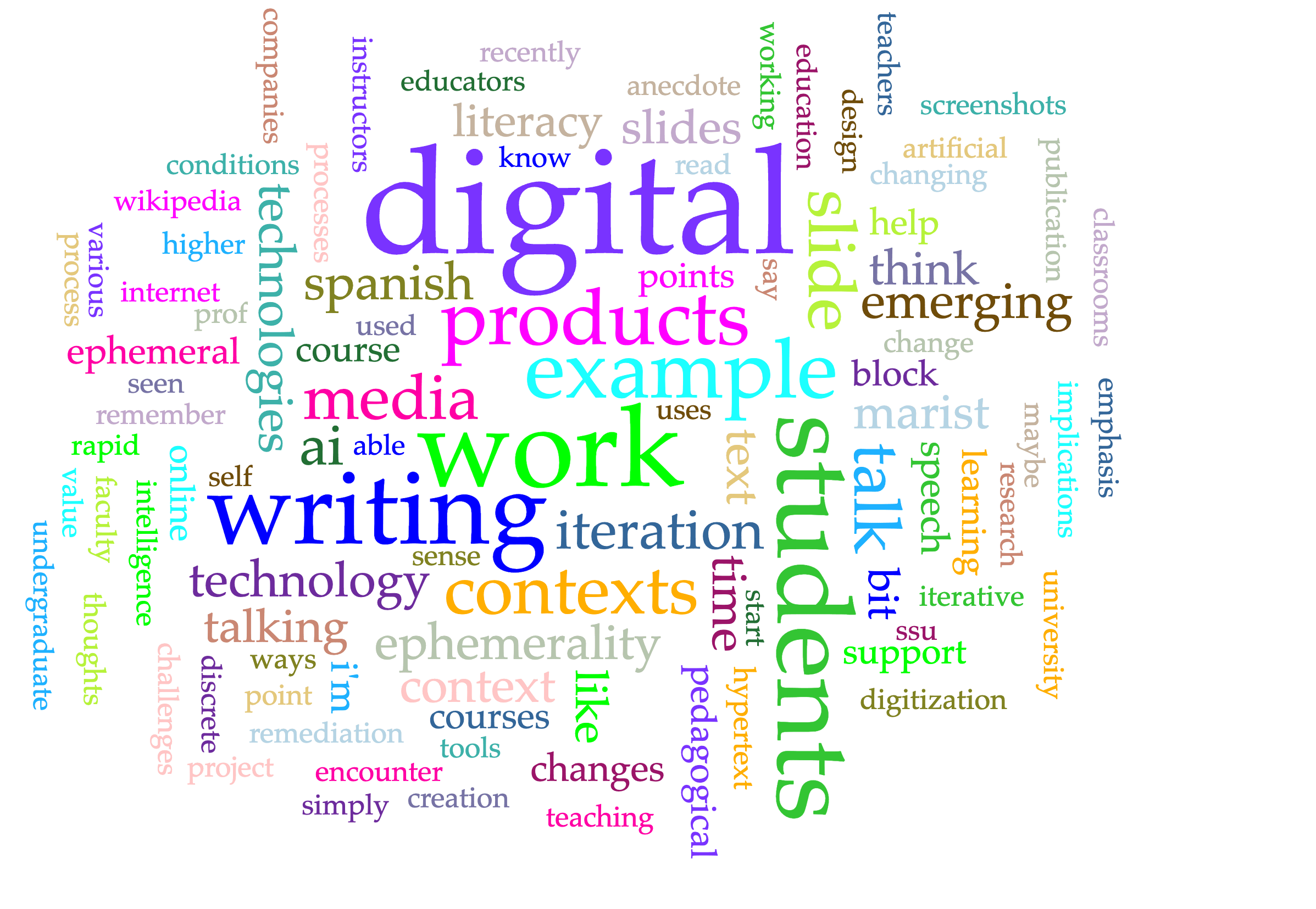
Screenshot of a word cloud drawn from draft notes of this talk, created with Voyant
A digital initiative involving the creation of a dataset may seem challenging to deploy in certain course contexts. But data literacy is a topic that resonates across our campus, whether in student-facing work explicitly tied to AI literacy, data implications related to course objectives, or the ways we are viewed and perceived as and through data in our personal and professional lives. Digital humanities practitioners have developed tools that can benefit in course contexts where you would like students to be exposed to core data and digital literacy concepts. I used to roll my eyes at slide decks that included word cloud visualizations. But I will say from experiences supporting undergraduate and graduate courses (and teaching my own) that open-access, web-based tools like Voyant can be great entry points to help students understand the implications of a world mediated by data.
screenshot of a DocuViz visualization of a Google Doc’s edit history (specifically, the notes used to compose this talk)
I also want to highlight DocuViz, a browser plugin created by Hana Research Lab at UC Irvine that allows users to visualize the edits made to Google Docs over time. Rather than using Google Doc version history to surveill students, I prefer approaches that make digital writing contexts like version history more transparent and accessible to students themselves, especially if these tools help students reflect on areas like time management, investments in revision, and collaborative writing dynamics.
I have worked with various instructors to develop lesson plans and assignments, occasionally visiting classrooms to facilitate or co-facilitate sessions too. Tools like Voyant and DocuViz are interactive and participatory opportunities for students to experiment with their own chosen texts and contexts, or to apply course discussions and models of data creation and analysis to selected course materials. While some prognosticators have emphasized the need to prioritize potential employees with explicit AI experience, I would argue that CTLs can shore up digital literacy expertise beyond this narrow, tool-based, product-entwined form of support. I’ve even used pen and paper and whiteboards to create small datasets and visualizations with students. This work is ultimately ephemeral but impactful.
Screenshot of a Microsoft Copilot chatbot question requesting an overview of the Louvre Museum
Some students (and colleagues) value the frictionless experience that AI chatbots like Microsoft Copilot seem to provide them. But these workflows create distance between users and the iterative and networked realities of knowledge and cultural production. Many chatbots have revised their interfaces to include citational materials, but these elements often obscure key contextual elements of how information changes and varies across time and space, choosing instead to amplify data mediated by search engine optimization methodologies, conditions of digital media that are not immediately clear in these clean and tidy outputs.
Wikipedia citations and edit history visualization of “Louvre Museum” page
Wikipedia data has been an important component of many AI datasets due to its openness and scale. But AI has also revealed how important the design and interface of Wikipedia is to information literacy. While the sheer amount of hyperlinks and avenues of inquiry can be initially overwhelming to some users, Wikipedia (and the visualization and data-oriented tools developed by its community) can help students see debates around information and ideas over time, the implications of citing and relying on particular sources, how perceptions of value change over time, how a topic is described and contextualized in one language compared to another. Wikipedia is not a perfect resource due to concerns about bias and the authority of particular editors and citational sources, but it also reveals these tensions and discussions in its edit histories and forums, unlike chatbots.
I’ll conclude with some of the questions I’ve been thinking about in light of these recent experiences. My hope is that the challenges of this particularly disruptive and still-iterating moment might lead to opportunities for CTLs and other forms of faculty and classroom support to reflect on the role that investments in digital literacy beyond AI might play in our missions, resource development, and expertise.
How do we critique and reject pedagogical responses that prioritize technological adoption and acceptance, forms of surveillance, idealizations of “rigor” (among other impulses) via an emphasis on “process” over “product” in the classroom?
How can educators use the iterative dimensions of digital media and emerging technologies to help students understand how cultural and knowledge production works (and changes over time) in their fields and in the institutions they reside in?
What questions do these approaches to digital literacy raise about how centers for teaching and learning (and other forms of faculty support) are best situated to support instructors, programs, and institutions (and their students)?
Jim McGrath (he/him) is an Instructional Designer at Salem State University’s Center for Teaching Innovation. He can also be found on LinkedIn and Bluesky. Feel free to reach out if you have questions or comments!
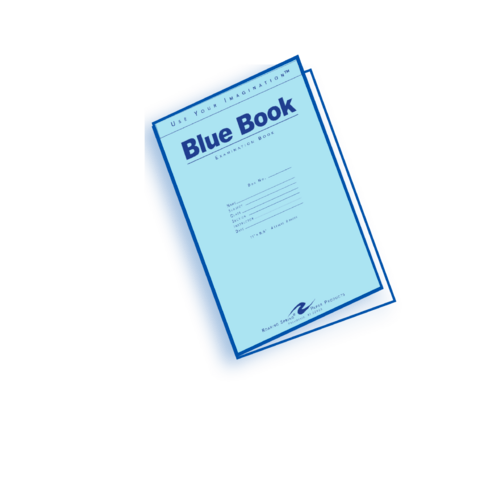
“Blue books” are once again changing the landscape of assessment in higher education. While the instructors who are turning to these technologies may view blue books as a revival or a return to a familiar medium, many of our students do not know what they are and do not have much experience using them in formal assessment contexts. We talk a lot about the “disruption” created by the arrival of AI, but I don’t see this framing used as much in the context of blue books. Blue books, like desks, whiteboards, and textbooks, are a technology, despite their tendency to be reinscribed as a corrective to the disruptions created by technologies like AI.
In February of 2013, the University of Virginia’s alumni magazine published a short piece titled “Blue books: The agony and ecstasy of final exams.” The authors playfully noted that “the sight of a blue (or green) examination book might cause stomachs to churn and bring back memories of frantic essay writing and cramped hands.” I call this tone “playful” because for this audience, blue books were a relic of the past, capable of continued psychological harm but no longer an active concern in the lives of these readers. The blue book submission selections in the piece emphasize some of the challenges students faced adhering to this pedagogical format: anxiety around legible handwriting and penmanship,frustrations over time constraints, an occasional need to have prose spill over onto margins and back covers. The word “Sorry” appears more than once in the sample student submissions curated here.
The re-emergence of blue books in the United States has been covered in higher ed news outlets as well as in mainstream publications like The New York Times. Some pieces, like the NYT one linked to in the previous sentence (authored by a vice provost at New York University), observe the return of “medieval options” with some skepticism and concern. But they also predict that the resurgence of these earlier forms of handwritten assessment may not be a short-term solution but a pedagogical revival with staying power: “Blue books and viva voce testing will live side by side with modern innovations like active learning and authentic assessment.”
I remember blue books from high school in the late 1990s. I went to an all-boys Catholic school (a prep seminary, in fact) and my freshman year English teacher was a fan of conformity and surveillance. He would require us to get our homework signed by our parents, although this policy was easy enough to subvert either by forgery or by a student signing their parents’ signatures on the first homework of the year, thereby setting their own penmanship as the default. He also required us to write all of our blue book exams in cursive. I protested this policy, having had issues over the years with the speed of cursive handwriting and the legibility of certain letters. I am also left-handed, a “condition” that was challenging to navigate in classrooms full of right-handed desks, in addition to tendencies to smudge and obscure my own handwriting if I did not hold my hand a certain way as I wrote. These classroom policies are the main things I remember from this instructor’s class. The policies became the priority, not the literature, the investments in writing, the use of language to articulate one’s place and perceptions. I would eventually receive the school’s English award as a graduating senior and go on to get a doctorate in English. I’m not sure what that instructor is up to these days but I hope some things have changed over time.
I also remember using blue books as recently as graduate school, where they were the testing medium of choice for in-person language proficiency exams. I took those tests in the late 2000s as a doctoral student. I believe my doctoral preliminary exams had shifted over to our department computer lab by then, but they were used on midterm and final exams during my undergraduate career (1999-2003) and I know I did take my MA comprehensive exams in blue books in 2005. I remember one student getting up and abruptly leaving the room early on in the exam process. It was a stressful way to gauge knowledge that seemed archaic at the time, justified by our instructors as a means to identify “knowledge at our fingertips” in relevant professional contexts. Even before the ubiquity of smart phones and data plans, this rationale was infuriating due to the presence of laptops and the ability to access troves of online resources via campus wifi networks. Some instructors would also say things like “Well, I had to take these tests too.”
How many undergraduates and graduate students enrolled in courses in the U.S. in 2025 have been required to submit major assessment work in their own handwriting? Teachers in K-12 contexts during the early twenty-first century have noted that the Common Core Standards Initiative (or “Common Core”), which many states adopted in the early 2010s, placed more of an emphasis on instruction in typing than in handwriting or cursive. Handwriting did not disappear entirely from curriculum across the country, though its de-centering did have a clear impact on its ubiquity and its prioritization. For example, a 2017 article in the American Journal of Occupational Therapy notes that for New York State public school teachers, the need to devote time to other Common Core standards made it difficult to address student handwriting needs related to difficulties like “grip, letter formation, spacing, motor memory, fine motor skills, perceptual problems, legibility, and poor habits.”
Are the college instructors who have made an abrupt shift to blue book exams, quizzes, and essays thinking about these sorts of challenges and the need for additional instruction and support? Are writing centers at college institutions devoting new resources to handwriting and developing programming to support students? As someone who works in a Center for Teaching and Learning (CTL) at an emerging Hispanic-Serving and Minority-Serving Institution (HSI-MSI), I am also thinking about the impact of handwritten assessment on first generation college students, students who are still developing their communication skills in Standard English, and students with accessibility needs who may be unable to complete or access handwritten course content and assessment activities.
It has been odd at times to see the response to one type of disruption be the introduction of another form of disruption. Handwritten assessment and blue books may be technologies that are familiar to many of us from our teaching and learning contexts, but our students likely have different experiences. I do think that many educators who are invested in handwritten course contexts are thinking more carefully about the implications of handwriting on their classrooms and the experiences of their students. I have talked with instructors who don’t use handwriting on major assessment activities, who clearly anticipate and provide accommodations for students who may not be able to participate in course contexts that involve handwriting, who provide research and readings to help students understand why they value handwriting in specific instances, who encourage student feedback and self-reflection on these experiences. But I can also see blue books entering classrooms with very little scaffolding, context, or guidance offered to students who may not have known what a “blue book” was prior to an instructor’s course. And the motivations behind these pivots to earlier technologies seem predicated more on desires to control and constrain conditions of learning than invested in pedagogical best practices.
The disruptions created by AI are real and troubling for instructors, students, and lots of other members of our campus communities. I understand why the people turning to blue books are resorting to these alternatives. And I think that the weight of a profession and the institutional policies its members reside in have in many ways made a challenging time in higher education even worse for instructors teaching right now. So I am sympathetic to the initial impulse to look towards the blue book as a solution to a current pedagogical problem. But I think we need to take a minute to reflect on the implications of these returning technologies after we have that initial thought. Like AI, blue books can have a rippling effect on learning beyond the individual classroom.
In the United States right now, the political and economic spheres continue to be bullish on the potential of AI, and those conditions have resulted in educators continuing to navigate new tools, desired use-cases, and pressures that can entice students (and colleagues) towards AI use-cases that may not be in individual or collective best interests. And the labor conditions of higher ed in the U.S. writ large can make it challenging for institutions and employees to address disruptive conditions, given that disruptions can take time, staffing, money, and resources to address. And as we saw during the early portion of the global pandemic, educators are expected to clock in and maintain investments in school year and semester trajectories regardless of what may be happening in the world that can impact attendance and learning conditions.
I am curious to see higher ed examples of engagement with handwriting and the various types of activities and conversations that might arise from the increased interest in this topic. I am less interested in romanticized notions of handwriting that seem to ignore the realities that I and other students from earlier times endured via handwritten assessment expectations. And I think that educators who are too quickly turning to blue books in pursuit of a solution to an emergent problem may be ignoring the additional problems that this decision might create in their classrooms.
The views expressed here are my own and may not reflect the sentiments of my employer or my colleagues.
As I’ve previously discussed on my blog, I am one of the nodes in the network of faculty, staff, and student support helping our campus community navigate the implications of AI on teaching and learning. Salem State University’s Center for Teaching Innovation continues to support folks throughout the summer, so as part of a “Summer @ CTI” June initiative I suggested a session that helped instructors who may be feeling overwhelmed by the wide range of tools, resources, and debates related to AI in higher education. We have previously used checklists in other professional development contexts, since they tend to work well as starting points that we can use to anchor live programming and then disseminate asynchronously to folks who can’t make live sessions.
The bare-bones checklist you see at the top of this post is designed as a pared-down starting point, but it’s accompanied by additional questions for folks to consider as they review upcoming courses and plan relevant materials.
Why ADAPT?
AI is a big and disruptive topic; it can be hard to know where to start in terms of course design
ADAPT is informed by SSU AI Advisory Group outreach and conversations re: immediate needs across classrooms here; soliciting feedback and perspectives across campus is an important component of resource development (and some of the concerns informing our checklist may align with your own)
For example, our office places a strong emphasis on the value of “AI literacy” rather than “AI evangelism”; many of our students, faculty, and staff wish to know more about this topic but also have concerns related to climate impact, copyright, misinformation, bias (among others)
ADAPT is a framework to get started and a recommended approach; it’s designed to help instructors self-assess their emerging AI literacies and plan next steps related to their more immediate course design priorities
AI Literacy
“AI Literacy” is a frequently deployed phrase in teaching and learning contexts, but it can be helpful to consider more specifically what “AI literacy” might entail.
For example, in reviewing resources on this topic, I came across a 2024 framework developed by Michelle Kassoria, Maya Georgieva, and Allison Papini published by EDUCAUSE:
I found these four areas to be helpful, but in talking with our faculty I decided to rephrase them into more colloquial language (while also sharing their point of origin) and de-emphasize certain elements (for example, many of our faculty are still weighing the benefits of application, integration, and implementation):
Technical: What are large language models? What are chatbots? What are hallucinations?
Evaluative: Can we slow down and test some of this stuff out more? Do I have an idea for what I’d like to test, and why?
Practical: Am I OK with students using some of these tools in specific course contexts? What do they need to know? Who else is using this stuff in their classrooms?
Ethical: Should I be using this stuff myself? Should I have information to share with students about what not to do?
More specifically, I shared some particular contexts and lines of inquiry that we have found helpful in our own emerging AI literacy work:
Moving from “AI” in the abstract to considerations of specific AI tools and use-cases in our classrooms and fields
Identifying “ethical implications” in specific contexts and in relation to core community values (for example, SSU’s HSI-MSI status)
Developing learning outcomes that address the impact of AI tools and use-cases by students, faculty, and staff
Reviewing specific implications for higher ed (teaching, assessment, emerging K-12 classroom AI use-cases)
Accepting that “AI literacy” is ongoing and what it entails will change as new tools, use-cases, and perceptions continue to emerge and change
What might AI literacy look like across campus and beyond an individual course? I shared some suggestions and ideas and referenced some ongoing work we are involved with here at the CTI, including:
Assessment of AI syllabus language and course policies
AI’s impact on student support/student success work
AI and Academic Integrity resources for faculty, staff, and students that prioritize equity, encourage AI literacy, assess impact on research/writing
Department-specific support and dialogue on AI’s impact
AI’s impact on student professional development/experiential learning
Transparency and piloting in potential administrative uses of AI
AI and Assessment Design/Redesign
In introducing ADAPT, we spent a bit of time discussing the particular challenges instructors face regarding assessment design.
We started with a consideration of framings that recommend “AI-proof” or “AI-resistant” assessment activities, with the following points of emphasis:
“AI-Proof” language may be useful when searching for assignments to model, but most assignments can be completed/aided by generative AI tools accessible to students.
“AI-Resistant” assignment recommendations acknowledge this reality. That being said, consider whether your assignment is “AI-Resistant” at the expense of teaching and learning.
For example, consider the negative pedagogical implications of handwritten major assessment activities, surveillance technology, and onerous submission guidelines on student success.
If an AI tool can be used by a student to outsource and complete an assignment, that doesn’t necessarily mean that you shouldn’t assign that assessment activity! But you may want to be transparent and direct with students about these possibilities, their limitations, and their impact on learning
I shared some general recommendations with instructors about assessment after AI:
Start by explaining the value of completing this assignment within your desired parameters (with or without AI). Encourage questions.
Scaffolded assignments that use small assessment activities/in-class work may discourage some AI usage beyond your course policies; the value of working iteratively/incrementally should be made clear to students.
Some instructors have increased usage of archival materials/special collections and field work/experiential learning productively.
Some instructors have used multimodal/presentation outputs productively.
Rubrics that anticipate the quality/tendencies of AI outputs may also discourage some AI usage beyond course policies.
I also noted that instructors who have encouraged or modeled use of AI tools in assessment activities tend to:
Emphasize use of specific, vetted tools (at SSU, instructors and students can access Copilot/Gemini licenses that have been vetted by our ITS department for use)
Identify specific points in assignment workflows to introduce/consider AI tools (brainstorming, copyediting, code review, audience/genre activities)
Model genres/use-cases from specific professional contexts relevant to the course
Incorporate AI tools in smaller assessment or ungraded assessment activities
Incorporate self-reflection requirements to help students assess the experience of using AI
For interested faculty, I also suggested a self-assessment approach for assessment activities that may be impacted by AI use-cases:
Use SSU’s Copilot or Gemini accounts (or your own vetted AI tools) to gauge what an AI output generated by a student might look like.
Reflect on the quality (or lack of quality) of the output. How would you discuss this use-case with students? What is lost from outsourcing this work to AI?
What might be gained from incorporating AI into some component of the current assignment or a revised assignment? How would you discuss this use-case with students? Why might you still refrain from allowing this use-case?
How would a current or revised rubric help you assess this assignment and guide students towards what they should prioritize in this work?
How might you revise this activity and still maintain the course outcomes associated with it?
Next Steps
ADAPT was introduced in a 90-minute virtual workshop (attended by around 20 or so instructors and staff). Attendees were compensated for their attendance. Before the session, they were asked to have a syllabus (or notes for a new course) in mind, as well as at least one major assessment activity. They were also asked to send an informal follow-up message (around 250 words in length) via email to reflect on the workshop and identify/discuss relevant areas of interest and concern.
The ADAPT checklist was designed to function as an asynchronous resource due to available time for professional development, instructor preferences, and to acknowledge that it is summer and folks may have other priorities. But we do really see it as a starting point that will ideally lead to additional conversations and discussions with faculty support sectors like CTI and with department/cross-campus colleagues.
ADAPT is one of several support initiatives we are providing to our faculty to help navigate the implications of AI. I’ll try to share other work and efforts if they seem useful in contexts beyond our own institution.
As I note in the checklist document, I am happy to talk more. I am sharing more of my AI work here because I have been encouraged to do so by colleagues and because I am hoping to model some AI literacy efforts that do not begin or end with AI adoption as an inevitability.
Note: The views expressed in this post may not be shared by my employer or all of my colleagues and should not be regarded as an institutional or departmental perspective.If you’d like to talk more, feel free to email me at jimmcgrath[dot]us[at]gmail
Since the Fall of 2022 (shortly after the public rollout of ChatGPT’s publicly-accessible GPT-3.5 version), a not-insignificant portion of my day job as an instructional designer has involved assessing, discussing, and sharing information about the impact of artificial intelligence (and especially generative AI tools like chatbots and agents) on higher ed. Most of that work has primarily been intended for local audiences here on campus, aside from a presentation on AI and digital literacies at 2023’s Massachusetts Colleges Online Conference. I’ve facilitated information sessions and faculty panels on AI, run faculty professional learning communities, led workshops, developed resources (for the university as well as for programs and individual courses), had lots of consultations and conversations (mostly with faculty and staff due to my faculty-facing role, but I have been fortunate to talk to many students too), contributed to spaces like the POD network’s AI listserv (which I recommend!), and attended dozens and dozens of webinars and professional development events. I’m currently co-facilitating an AI Advisory Group made up of a wide range of campus stakeholders and we’ll be sharing some recommendations with our campus community and with university leadership in the coming months; I will share anything relevant on this website as I shore up my instructional design content here.
There are a few reasons why I haven’t said much publicly about my work in the AI and higher ed space: it’s a contentious topic (especially on social media networks like Bluesky); it’s a topic I wanted to learn more about; it’s a topic that I’m interested in but not necessarily enamored of; in 2022 I was still relatively new (two years in) to instructional design work and unsure of what my professional future might hold; professional writing for academic publication is not something I am paid to do and is not a core lens through which I am assessed; I had other stuff going on in my life (mostly good!); I just didn’t really want to (among other reasons).
But I’ve been encouraged to amplify my perspective in this area and I do have more time to dedicate to this sort of writing, so here we are. I’ll also note that my experiences are mostly within United States higher ed contexts (though I do research more broadly beyond those borders and have valued many of the perspectives I have come across). I wanted to start this pivot to more public writing on AI and higher ed by outlining what I am most interested in right now regarding this topic.
In the AI and higher ed worlds, we see a lot of energy and discussion dedicated to the topics of “AI literacy” and “digital literacy” more broadly. If you’ve had any ties at all to higher ed over the last half-decade, you know that the onset of the global pandemic resulted in a major pivot to investments in online learning modalities, especially online synchronous (and perhaps to a lesser extent, online asynchronous) learning modalities. The conditions (primarily economic) motivating this pivot also amplified some troubling realities regarding the range of digital resources and digital literacies possessed by higher ed’s institutions. For example, while many colleges have provided instructors with learning management systems (LMSs) like Canvas and Blackboard for decades, it was clear that not all instructors were well-versed in their features and components, suggesting that their usage varied wildly depending on the institution, department, or program. New technologies like Zoom and classroom multimedia were quickly rolled out to meet new modality requirements in time for Fall 2020 semesters. Even instructors who would not self-identify as emerging technologists struggled at times with the timeline of technological adoption and course remediation, especially in course contexts where in-person interactions with course materials, instructors, and classmates seemed more ideally suited to both course objectives and instructor experiences. The need for continued employment and reliable income motivated many instructors to comply with these disruptive learning conditions, as did more general social and cultural investments in certain ideas of “normalcy” and production.
OpenAI launched ChatGPT in November 2022, its own rippling effects running right into the ripples of the two and a half years dedicated to pandemic teaching practices (depending on when or if or how you believe that we arrived at a “post-pandemic” existence in the U.S.). I was just watching a webinar earlier today that presented a tidier narrative of this shift of attention from pandemic learning to AI learning. The speaker seemed to be viewing (or at least rhetorically situating) the latter as a continuation of the digital literacy investments central to pandemic teaching. In fact, that time period felt more like escaping a sinking ship and finding some relatively sturdy wreckage to cling to, only to look out and discover that the water was infested with sharks. Faculty and student support resources are often tasked with the rescue mission. Unfortunately, we are also potentially part of the dinner menu for those same sharks; in many metaphorical respects, we are floating right next to those faculty members and similarly worried, fatigued, and frustrated.
The first iteration of our center’s resource page on “Teaching In The Age of AI” launched in the early Spring of 2023 to provide some support to instructors looking for advice on how to navigate chatbots and their emerging impact. Most of that initial advice stressed an abundance of caution and acknowledged that the form and impact of AI were still in the early stages. We encouraged folks to learn more about the topic, sharing emerging research and inventorying the more visible tools and terms that we encountered. We recommended that instructors talk directly with students about their current perspectives on AI and its relevance to coursework, course topics, and relevant professional contexts, regardless of whether those points of view were skeptical, excited, or somewhere in between. And we encouraged instructors not to use AI detectors due to the prevalence of “false positives” and the negative effects that usage may have on the student learning experience. At the same time we were evaluating AI’s relevance to our work as instructional designers and faculty support, considering our own digital literacies, consulting with regional and national colleagues, reading AI news coverage from higher ed outlets and major news media, scanning social media, and encountering some emerging examples of practitioners and tools that seemed designed to either augment or replace some of the core tasks we provided our campus community.
It was interesting to encounter the early AI adopters and advocates in higher ed during these information-gathering efforts. It was especially clear to me that some individuals saw AI’s disruption as an opportunity to improve their individual standings in particular institutions or in higher ed more generally. Not all of these sources of AI perspectives seemed to operate along these lines, even if their visibility did benefit from their emergence as trusted and informed resources. As I previously mentioned, POD’s AI listserv became (and remains) a valuable network for folks to raise questions, share perspectives, articulate emerging critiques, highlight resources. I’ll focus on my own positive experiences with a few people there and elsewhere in case you’re looking for additional points of view (and I’ll note that this is by no means an exhaustive list or a curated selection of folks who all view AI exactly the same way):
Anna Mills and John Warner, who have primarily focused on AI’s impact on writing and writing instruction
Many of those voices and perspectives have circulated widely and visibly in higher ed’s considerations of AI. At the same time, I have noticed that some of the louder voices in higher ed on this topic tend to skew more towards AI adoption, if not “AI evangelism.” I view the AI Evangelist as a speaker who might:
Speak sententiously about an abstracted “AI” to insist upon its unquestioned importance
Lean into fearmongering with phrases like “AI won’t replace you, but someone who knows how to use AI will”
Dismiss concerns about AI’s climate impact by reminding their audience that they too, consume energy doing things in modern life
Invoke “ethics” without really providing a response to the ethical considerations that have led their peers to think more carefully and specifically about AI’s role in higher ed’s future
Compare AI to earlier technological disruptions or innovations while ignoring the frictions, critiques, and short and long-term impact of those technologies and their initial perceptions and economic valuations (Web 2.0, social media, email, smart phones, among many others)
Prioritize the ideals of management culture and their dreams of AI efficiency at the expense of other forms of labor
Ignore, obscure, disavow, or dismiss their individual success (professional, economic, attention-based) at the expense of our collective benefit as laborers in higher ed
It’s these last two bullet points that I’d like to linger on for a bit longer here. To be honest, I am starting to write about this topic in large part because I think that “labor literacy” is something that educators need to talk about and think about more within the contexts of AI literacy and digital literacy. Readings of technology through the lens of labor ideally have investments in intersectionality as well and likely consider non-digital contexts. Here I am thinking of books like:
To return to the more specialized terrain I invoked at the outset, I have reached a point where, moving forward, I am primarily interested in considerations of AI’s impact that reckon with questions of AI literacy, digital literacy, and labor literacy. For example, one of the talking points valued by AI Evangelists as well as well-intended faculty and staff has been the potential role that AI can play in what is increasingly (and unfortunately) called “workforce development.” The perspective on workforce development might cite recent surveys of managers and industry leaders, tout examples of labor “efficiency,” promise employees that the work they are less enthused about will one day be automated. Many of these positives are rhetorically framed as benefits to the early-career employee, the recent college graduate. Rarely, if ever, do we hear representatives from higher ed speak with such urgency about, say, the potential benefits of creating space in the curriculum to teach students how to join or start unions, review the recent history of organized labor, consider the role that data surveillance plays in employee assessment and management culture. Why are the calls for labor literacy not as loud as the calls for AI literacy in this contemporary moment? I have asked this question at a few recent AI webinars, and I can’t recall the question being acknowledged by the speakers, let alone answered.
To conclude for now, what might the intersection of AI literacy, digital literacy, and labor literacy look like in higher ed? I’m still thinking about this question. Here are a few more specific lines of inquiry:
How do investments in AI usage impact institutional commitments to sustainability (often articulated in university strategic plans)?
How does AI usage impact employee-created data in higher ed and its present and future uses: course materials, video lectures, LMS content, research publications, posters / presentations?
What AI tools are approved for community usage and how are they assessed (and later reviewed and reassessed, if needed)?
How do campus sectors with various areas of expertise (in course design, student success, accessibility, among other areas) evaluate AI’s implications on their work? What opportunities for institutional collaboration and support are available?
How do particular investments in particular types of AI literacy impact particular types of campus labor, and what resources are made available for professional development, expanded job responsibilities, additional labor costs and needs?
How is AI literacy viewed as an ongoing initiative and supported with relevant resources: technologies, staffing, training, etc.?
How are the benefits of certain AI tools and use-cases disseminated to faculty and staff and what are the expectations of usage in these contexts?
How is faculty autonomy complicated by concerns about AI: pivots to handwritten modalities of labor in classroom activities, uses of surveillance technology to assess content copied and pasted into writing interfaces, assessments of student work that claim to identify student AI usage, core digital literacy expectations of faculty and students, among other areas?
How do institutions balance desires for speed and efficiency in digital literacy contexts with concerns about other core digital literacy needs for students, especially students who may have been negatively impacted by early pandemic conditions?
When should classrooms and courses align more closely with relevant professional contexts and when might they productively resist or reimagine those conditions of labor in ways that align with course or program goals (as opposed to workforce goals)?
What if we reframed events like the rise of AI less as disruptive events requiring immediate action and reconsidered paces of adoption, implementation, allocation of resources within the larger context of university aims and motivations?
An emphasis on labor literacy slows down the AI adoption process and the aspirations AI Evangelists have for a more efficient university, but I would argue that the various laborers in higher ed would benefit from leaning in to some of the frictions generated (sorry) by AI’s increasing ubiquity in lieu of sanding them down with rosy pictures of an inevitably human-centered future alongside this latest set of technological innovations. We’ve seen the dark side of the “move fast and break things” approach too many times now. Many laborers in higher ed have organized in part to encourage their institutions to slow down and consider the long-term implications of their decisions.
That’s where my head is at in March 2025. I will try to write a bit more about this topic, though the format and aims might vary. For now, I thought it was important to outline my own emerging investments in these three areas and where I see them as overlapping and intersecting.
I’ll close by noting that I would not describe myself as an AI Evangelist, Apologist, or Advocate, but I have seen some promise in particular applications of AI tools in particular higher education contexts. Much of that work is preliminary or exploratory, though! I have spent a fair bit of time assessing particular AI tools within the context of my own work as an instructional designer and have found benefits to certain applications to tools to more mundane tasks like, say, developing a meeting agenda. But I haven’t neatly integrated any tools within workflows. I’m also happy to hear from colleagues with their own experiences and contexts as they consider where AI tools may fit into their own efforts, and I try to balance providing my own perspectives on these topics with the realities of serving a pretty wide and varied community of educators.
Note: The views expressed in this post may not be shared by my employer or all of my colleagues and should not be regarded as an institutional or departmental perspective.If you’d like to talk more, feel free to email me at jimmcgrath[dot]us[at]gmail