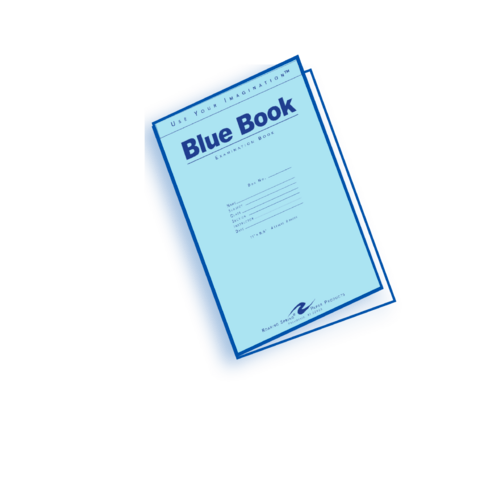
“Blue books” are once again changing the landscape of assessment in higher education. While the instructors who are turning to these technologies may view blue books as a revival or a return to a familiar medium, many of our students do not know what they are and do not have much experience using them in formal assessment contexts. We talk a lot about the “disruption” created by the arrival of AI, but I don’t see this framing used as much in the context of blue books. Blue books, like desks, whiteboards, and textbooks, are a technology, despite their tendency to be reinscribed as a corrective to the disruptions created by technologies like AI.
In February of 2013, the University of Virginia’s alumni magazine published a short piece titled “Blue books: The agony and ecstasy of final exams.” The authors playfully noted that “the sight of a blue (or green) examination book might cause stomachs to churn and bring back memories of frantic essay writing and cramped hands.” I call this tone “playful” because for this audience, blue books were a relic of the past, capable of continued psychological harm but no longer an active concern in the lives of these readers. The blue book submission selections in the piece emphasize some of the challenges students faced adhering to this pedagogical format: anxiety around legible handwriting and penmanship,frustrations over time constraints, an occasional need to have prose spill over onto margins and back covers. The word “Sorry” appears more than once in the sample student submissions curated here.
The re-emergence of blue books in the United States has been covered in higher ed news outlets as well as in mainstream publications like The New York Times. Some pieces, like the NYT one linked to in the previous sentence (authored by a vice provost at New York University), observe the return of “medieval options” with some skepticism and concern. But they also predict that the resurgence of these earlier forms of handwritten assessment may not be a short-term solution but a pedagogical revival with staying power: “Blue books and viva voce testing will live side by side with modern innovations like active learning and authentic assessment.”
I remember blue books from high school in the late 1990s. I went to an all-boys Catholic school (a prep seminary, in fact) and my freshman year English teacher was a fan of conformity and surveillance. He would require us to get our homework signed by our parents, although this policy was easy enough to subvert either by forgery or by a student signing their parents’ signatures on the first homework of the year, thereby setting their own penmanship as the default. He also required us to write all of our blue book exams in cursive. I protested this policy, having had issues over the years with the speed of cursive handwriting and the legibility of certain letters. I am also left-handed, a “condition” that was challenging to navigate in classrooms full of right-handed desks, in addition to tendencies to smudge and obscure my own handwriting if I did not hold my hand a certain way as I wrote. These classroom policies are the main things I remember from this instructor’s class. The policies became the priority, not the literature, the investments in writing, the use of language to articulate one’s place and perceptions. I would eventually receive the school’s English award as a graduating senior and go on to get a doctorate in English. I’m not sure what that instructor is up to these days but I hope some things have changed over time.
I also remember using blue books as recently as graduate school, where they were the testing medium of choice for in-person language proficiency exams. I took those tests in the late 2000s as a doctoral student. I believe my doctoral preliminary exams had shifted over to our department computer lab by then, but they were used on midterm and final exams during my undergraduate career (1999-2003) and I know I did take my MA comprehensive exams in blue books in 2005. I remember one student getting up and abruptly leaving the room early on in the exam process. It was a stressful way to gauge knowledge that seemed archaic at the time, justified by our instructors as a means to identify “knowledge at our fingertips” in relevant professional contexts. Even before the ubiquity of smart phones and data plans, this rationale was infuriating due to the presence of laptops and the ability to access troves of online resources via campus wifi networks. Some instructors would also say things like “Well, I had to take these tests too.”
How many undergraduates and graduate students enrolled in courses in the U.S. in 2025 have been required to submit major assessment work in their own handwriting? Teachers in K-12 contexts during the early twenty-first century have noted that the Common Core Standards Initiative (or “Common Core”), which many states adopted in the early 2010s, placed more of an emphasis on instruction in typing than in handwriting or cursive. Handwriting did not disappear entirely from curriculum across the country, though its de-centering did have a clear impact on its ubiquity and its prioritization. For example, a 2017 article in the American Journal of Occupational Therapy notes that for New York State public school teachers, the need to devote time to other Common Core standards made it difficult to address student handwriting needs related to difficulties like “grip, letter formation, spacing, motor memory, fine motor skills, perceptual problems, legibility, and poor habits.”
Are the college instructors who have made an abrupt shift to blue book exams, quizzes, and essays thinking about these sorts of challenges and the need for additional instruction and support? Are writing centers at college institutions devoting new resources to handwriting and developing programming to support students? As someone who works in a Center for Teaching and Learning (CTL) at an emerging Hispanic-Serving and Minority-Serving Institution (HSI-MSI), I am also thinking about the impact of handwritten assessment on first generation college students, students who are still developing their communication skills in Standard English, and students with accessibility needs who may be unable to complete or access handwritten course content and assessment activities.
It has been odd at times to see the response to one type of disruption be the introduction of another form of disruption. Handwritten assessment and blue books may be technologies that are familiar to many of us from our teaching and learning contexts, but our students likely have different experiences. I do think that many educators who are invested in handwritten course contexts are thinking more carefully about the implications of handwriting on their classrooms and the experiences of their students. I have talked with instructors who don’t use handwriting on major assessment activities, who clearly anticipate and provide accommodations for students who may not be able to participate in course contexts that involve handwriting, who provide research and readings to help students understand why they value handwriting in specific instances, who encourage student feedback and self-reflection on these experiences. But I can also see blue books entering classrooms with very little scaffolding, context, or guidance offered to students who may not have known what a “blue book” was prior to an instructor’s course. And the motivations behind these pivots to earlier technologies seem predicated more on desires to control and constrain conditions of learning than invested in pedagogical best practices.
The disruptions created by AI are real and troubling for instructors, students, and lots of other members of our campus communities. I understand why the people turning to blue books are resorting to these alternatives. And I think that the weight of a profession and the institutional policies its members reside in have in many ways made a challenging time in higher education even worse for instructors teaching right now. So I am sympathetic to the initial impulse to look towards the blue book as a solution to a current pedagogical problem. But I think we need to take a minute to reflect on the implications of these returning technologies after we have that initial thought. Like AI, blue books can have a rippling effect on learning beyond the individual classroom.
In the United States right now, the political and economic spheres continue to be bullish on the potential of AI, and those conditions have resulted in educators continuing to navigate new tools, desired use-cases, and pressures that can entice students (and colleagues) towards AI use-cases that may not be in individual or collective best interests. And the labor conditions of higher ed in the U.S. writ large can make it challenging for institutions and employees to address disruptive conditions, given that disruptions can take time, staffing, money, and resources to address. And as we saw during the early portion of the global pandemic, educators are expected to clock in and maintain investments in school year and semester trajectories regardless of what may be happening in the world that can impact attendance and learning conditions.
I am curious to see higher ed examples of engagement with handwriting and the various types of activities and conversations that might arise from the increased interest in this topic. I am less interested in romanticized notions of handwriting that seem to ignore the realities that I and other students from earlier times endured via handwritten assessment expectations. And I think that educators who are too quickly turning to blue books in pursuit of a solution to an emergent problem may be ignoring the additional problems that this decision might create in their classrooms.
The views expressed here are my own and may not reflect the sentiments of my employer or my colleagues.