
Hi! Below you’ll find the text of a “PODTalk” I gave at the 2025 POD Network Conference in San Diego. This was my first time attending and presenting at POD and I really enjoyed my experience there. Thanks to CTI Director Eliza Bobek for allocating resources for this professional development opportunity, and thanks to my colleagues for their feedback and support.
Some of the content below is also informed by a recent virtual presentation I gave with Keja Valens and two students at the 2025 Latin American and Caribbean Digital Humanities Symposium. Very grateful to Keja for being a terrific collaborator and colleague at Salem State. We both learned a ton from our student presenters and the rest of the students we’ve done cookbook data work alongside!
Finally, just noting that the views expressed here may not reflect the sentiments of Salem State University or the views of my colleagues in SSU’s Center for Teaching Innovation.

During my senior year as an undergrad English major at Marist College (now Marist University!) in 2002-2003, I took courses with Prof. Mark Morreale that involved the creation and publication of various forms and genres of electronic writing. Using The Internet Archive’s Wayback Machine, I was able to recover segments of this work: a collaboratively-edited online edition of Jonathan Swift’s “Baucis and Philemon” is what you see screenshots of here.

The finished online products, then and now, were not particularly impressive. What I remember more from Prof. Morreale’s courses were the points of emphasis on process. For example, in his “Writing For The Internet” class, we toured the Marist library’s emerging digitization wing, learning about optical character recognition and its value. We read postmodern literature and brought those earlier texts into conversation with emerging hypertext fiction and academic perspectives on digital media. We remediated poems from page to screen and considered what was gained, lost, transformed, and obscured in digital writing and digitization work.
We focused on emerging digital trends and technological innovations, but this work felt more exploratory and inquisitive than deferential to a feeling that these changes were inevitable or all-consuming. We considered the affordances and limitations of new technologies, the earlier technologies mediating and informing our prior perceptions of literature, reading, and writing, the labor and expertise involved in book editing, web design, and digitization, the iterative and networked dimensions of knowledge production.

“Writing For The Internet” is ancient history compared to our current moment in higher education, where we are navigating the ongoing disruption caused by accelerations in artificial intelligence and hypercapitalist desires to embed this technology everywhere so that it becomes impossible to extricate from daily life. But I start here because I think we can learn from the ways it introduced ideas of digital literacy to students via slower, deliberate work around digitization and born-digital materials, data creation and use, and the motivations behind these uses of technology.

To be candid, I have grown increasingly concerned about our collective response to student perceptions of AI. I don’t view the outsourcing of classroom tasks to AI as indicative of a moral failing on the part of the students. The moral failings arise when institutional administrators claim that “AI is here to stay” without interrogating the motivations behind the managerial and corporate cultures that desire this interpretation of reality. Calls to reimagine higher education that retreat to pedagogical approaches which prioritize the authority of the instructor, surveillance mechanisms, management culture priorities, and discipline over discovery seem unconvincing, shortsighted, and a disservice to our professions and our students.

Higher education can and should play a role in labor literacy and we should view AI and other technological innovations and use-cases through the lens of labor. We should not prioritize the financial benefits of automation when they are reaped by a small management class further consolidating its wealth. Perhaps the students we encounter skeptical of “busy work” who don’t feel ethically compromised by the outsourcing of coursework to generative AI tools might be convinced to behave differently if their instructors clearly showed them what might be gained from other courses of action. Perhaps we might encourage the use of our campus classrooms as sites where questions, concerns, and critiques about desired personal and professional use-cases of AI might be centered as elements of productive and necessary friction rather than viewed as obstacles, hyperbole, out of touch with “reality”.
Now I’ll talk a bit about some recent work related to digital project development, assignment design, and AI literacy that I have taken up via my role at Salem State’s Center for Teaching Innovation. I try to prioritize low-lift, malleable examples due to the range of resources we all might possess: digital expertise, time, staffing, money. CTLs and other support sectors might use the specific context of AI’s impact to think more broadly about our investments in digital literacy and expertise in areas like staffing and professional development, approaches to programming and resource development, and opportunities to collaborate and iterate with departments, programs, and instructors.

For example, recently I had the pleasure of collaborating with Prof. Keja Valens in our English Department on a dataset creation project related to her interest in Caribbean cookbooks. We worked with a team of undergraduate researchers, introducing them to methodologies informed by digital humanities and ethnic studies. Students learned about the material, cultural, and social histories of various cookbooks, what we know and don’t know about recipes and their authors, what their ingredients tell us about transatlantic trade and the ways that colonial perspectives and power dynamics informed their creation and dissemination. They were also introduced to core concepts in data literacy: how datasets are created, organized, revised, visualized, analyzed, and disseminated by different researchers and audiences.
Some of this work could have been outsourced to generative AI tools But students reported that the time invested in tasks perceived by others as menial or even “mindless” data entry work felt integral to the project, in part due to the guidance, context, and opportunities for discussion and reflection we scaffolded around these activities. These experiences and sentiments also informed a Faculty Professional Learning Community I co-facilitated with English Department Chair Scott Nowka on Digital Ethnic Studies (funded in part by resources from the Digital Ethnic Futures Consortium), in hopes of further disseminating the value of this iterative work in data creation across campus.
Digital humanities methodologies might serve as useful counters and correctives to desires to prioritize AI outsourcing and integrations at the expense of pedagogy. Creating conditions of digital pedagogy that ask students to make, refine, and use datasets from primary sources like cookbooks can be done at various scales. Working with an emphasis on process as well as product can help students understand what is gained and lost from digital remediation, where spatial, cultural, linguistic, and historical contexts might be obscured or amplified via data creation and analysis, and why questions about audience, design, intended use, and ethical implications (among others) should inform the creation and use of digital tools and media in educational, professional, and personal contexts.
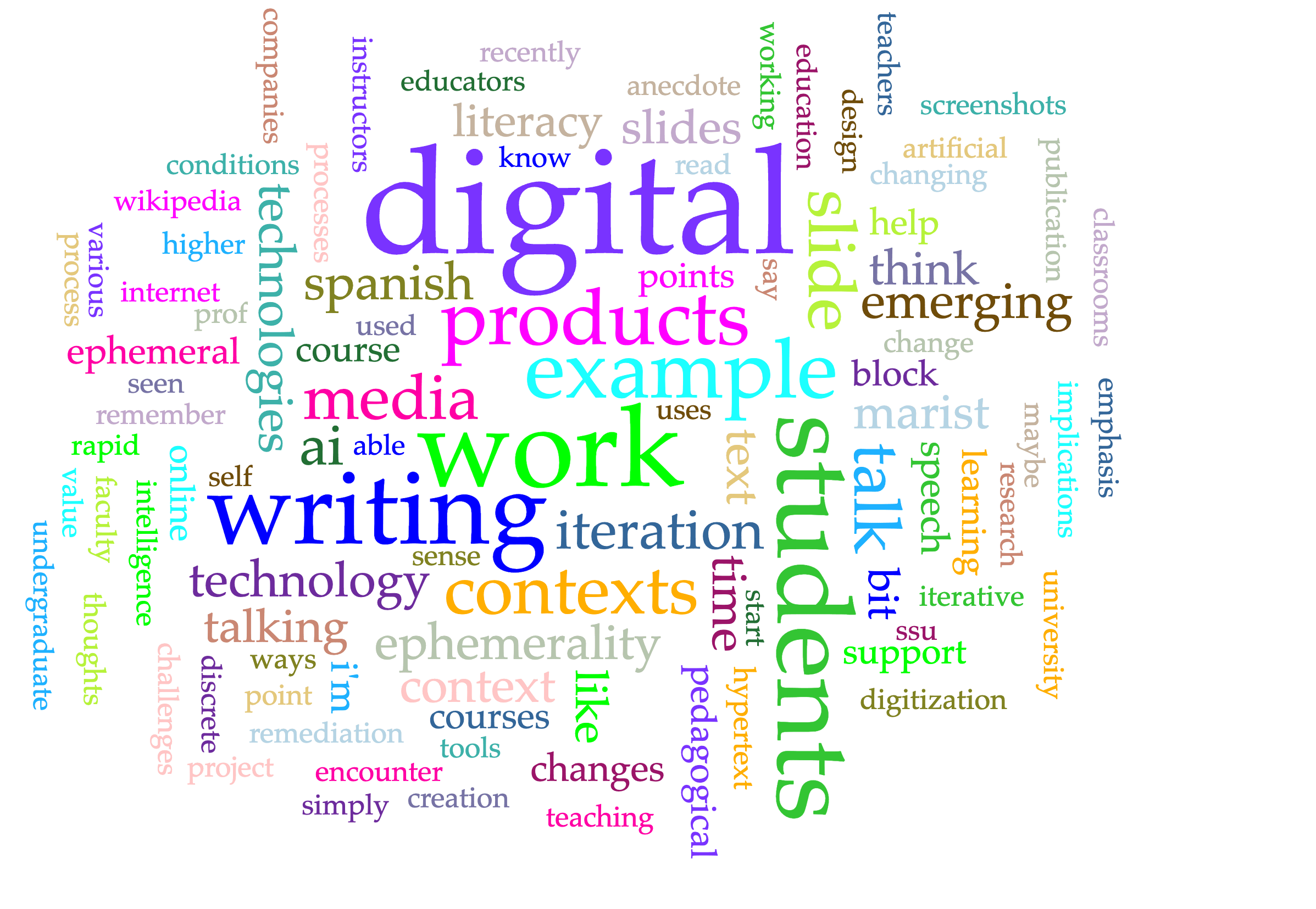
A digital initiative involving the creation of a dataset may seem challenging to deploy in certain course contexts. But data literacy is a topic that resonates across our campus, whether in student-facing work explicitly tied to AI literacy, data implications related to course objectives, or the ways we are viewed and perceived as and through data in our personal and professional lives. Digital humanities practitioners have developed tools that can benefit in course contexts where you would like students to be exposed to core data and digital literacy concepts. I used to roll my eyes at slide decks that included word cloud visualizations. But I will say from experiences supporting undergraduate and graduate courses (and teaching my own) that open-access, web-based tools like Voyant can be great entry points to help students understand the implications of a world mediated by data.

I also want to highlight DocuViz, a browser plugin created by Hana Research Lab at UC Irvine that allows users to visualize the edits made to Google Docs over time. Rather than using Google Doc version history to surveill students, I prefer approaches that make digital writing contexts like version history more transparent and accessible to students themselves, especially if these tools help students reflect on areas like time management, investments in revision, and collaborative writing dynamics.
I have worked with various instructors to develop lesson plans and assignments, occasionally visiting classrooms to facilitate or co-facilitate sessions too. Tools like Voyant and DocuViz are interactive and participatory opportunities for students to experiment with their own chosen texts and contexts, or to apply course discussions and models of data creation and analysis to selected course materials. While some prognosticators have emphasized the need to prioritize potential employees with explicit AI experience, I would argue that CTLs can shore up digital literacy expertise beyond this narrow, tool-based, product-entwined form of support. I’ve even used pen and paper and whiteboards to create small datasets and visualizations with students. This work is ultimately ephemeral but impactful.

Some students (and colleagues) value the frictionless experience that AI chatbots like Microsoft Copilot seem to provide them. But these workflows create distance between users and the iterative and networked realities of knowledge and cultural production. Many chatbots have revised their interfaces to include citational materials, but these elements often obscure key contextual elements of how information changes and varies across time and space, choosing instead to amplify data mediated by search engine optimization methodologies, conditions of digital media that are not immediately clear in these clean and tidy outputs.

Wikipedia data has been an important component of many AI datasets due to its openness and scale. But AI has also revealed how important the design and interface of Wikipedia is to information literacy. While the sheer amount of hyperlinks and avenues of inquiry can be initially overwhelming to some users, Wikipedia (and the visualization and data-oriented tools developed by its community) can help students see debates around information and ideas over time, the implications of citing and relying on particular sources, how perceptions of value change over time, how a topic is described and contextualized in one language compared to another. Wikipedia is not a perfect resource due to concerns about bias and the authority of particular editors and citational sources, but it also reveals these tensions and discussions in its edit histories and forums, unlike chatbots.
I’ll conclude with some of the questions I’ve been thinking about in light of these recent experiences. My hope is that the challenges of this particularly disruptive and still-iterating moment might lead to opportunities for CTLs and other forms of faculty and classroom support to reflect on the role that investments in digital literacy beyond AI might play in our missions, resource development, and expertise.
- How do we critique and reject pedagogical responses that prioritize technological adoption and acceptance, forms of surveillance, idealizations of “rigor” (among other impulses) via an emphasis on “process” over “product” in the classroom?
- How can educators use the iterative dimensions of digital media and emerging technologies to help students understand how cultural and knowledge production works (and changes over time) in their fields and in the institutions they reside in?
- What questions do these approaches to digital literacy raise about how centers for teaching and learning (and other forms of faculty support) are best situated to support instructors, programs, and institutions (and their students)?
Jim McGrath (he/him) is an Instructional Designer at Salem State University’s Center for Teaching Innovation. He can also be found on LinkedIn and Bluesky. Feel free to reach out if you have questions or comments!