
Tag: digital archives

  • Digital Processes, Not Products: Embracing Digital Ephemerality and Iteration

    Digital Processes, Not Products: Embracing Digital Ephemerality and Iteration

    Hi! Below you’ll find the text of a “PODTalk” I gave at the 2025 POD Network Conference in San Diego. This was my first time attending and presenting at POD and I really enjoyed my experience there. Thanks to CTI Director Eliza Bobek for allocating resources for this professional development opportunity, and thanks to my colleagues for their feedback and support.

    Some of the content below is also informed by a recent virtual presentation I gave with Keja Valens and two students at the 2025 Latin American and Caribbean Digital Humanities Symposium. Very grateful to Keja for being a terrific collaborator and colleague at Salem State. We both learned a ton from our student presenters and the rest of the students we’ve done cookbook data work alongside!

    Finally, just noting that the views expressed here may not reflect the sentiments of Salem State University or the views of my colleagues in SSU’s Center for Teaching Innovation.

    screenshot of an Internet Archive Wayback Machine capture of a 2003 digital annotation project of Jonathan Swift's "Baucis and Philemon" poem
    A 2003 undergraduate creative project from “Writing For The Internet” (Prof. Mark Morreale) by Jim and other students, digitally annotating Jonathan Swift’s “Baucis and Philemon” (Internet Archive screen captures; captures of student site accessible online via The Internet Archive’s Wayback Machine)


    During my senior year as an undergrad English major at Marist College (now Marist University!) in 2002-2003, I took courses with Prof. Mark Morreale that involved the creation and publication of various forms and genres of electronic writing. Using The Internet Archive’s Wayback Machine, I was able to recover segments of this work: a collaboratively-edited online edition of Jonathan Swift’s “Baucis and Philemon” is what you see screenshots of here. 

    screenshot of slide highlighting readings that informed Prof. Morreale's "Writing For The Internet" course, including: Hypertext 2.0 by George Landow; Hamlet on The Holodeck by Janet Murray; Remediation by Jay David Bolter and Richard Grusin; Radiant Textuality by Jerome McGann
    Screenshot of slide highlighting readings that informed Prof. Morreale’s “Writing For The Internet” course, including: Hypertext 2.0 by George Landow; Hamlet on The Holodeck by Janet Murray; Remediation by Jay David Bolter and Richard Grusin; Radiant Textuality by Jerome McGann

    The finished online products, then and now, were not particularly impressive. What I remember more from Prof. Morreale’s courses were the points of emphasis on process. For example, in his “Writing For The Internet” class, we toured the Marist library’s emerging digitization wing, learning about optical character recognition and its value. We read postmodern literature and brought those earlier texts into conversation with emerging hypertext fiction and academic perspectives on digital media. We remediated poems from page to screen and considered what was gained, lost, transformed, and obscured in digital writing and digitization work.

    We focused on emerging digital trends and technological innovations, but this work felt more exploratory and inquisitive than deferential to a feeling that these changes were inevitable or all-consuming. We considered the affordances and limitations of new technologies, the earlier technologies mediating and informing our prior perceptions of literature, reading, and writing, the labor and expertise involved in book editing, web design, and digitization, the iterative and networked dimensions of knowledge production.


    screenshot collecting several headlines related to AI's impact on higher education. Headlines include "AI can write better university assignments than students, report suggests"; "Alarmed by AI Chatbots, Universities Start Revampling How They Teach"; "What Will Determine AI's Impact on College Teaching? 5 Signs to Watch"; "Designing Assignments in the ChatGPT Era"
    Screenshot collecting several headlines related to AI’s impact on higher education. Headlines include “AI can write better university assignments than students, report suggests”; “Alarmed by AI Chatbots, Universities Start Revampling How They Teach”; “What Will Determine AI’s Impact on College Teaching? 5 Signs to Watch”; “Designing Assignments in the ChatGPT Era”

    “Writing For The Internet” is ancient history compared to our current moment in higher education, where we are navigating the ongoing disruption caused by accelerations in artificial intelligence and hypercapitalist desires to embed this technology everywhere so that it becomes impossible to extricate from daily life. But I start here because I think we can learn from the ways it introduced ideas of digital literacy to students via slower, deliberate work around digitization and born-digital materials, data creation and use, and the motivations behind these uses of technology. 

    screenshot of a quote from Matteo Pasquinelli's The Eye of The Master: A Social History of Artificial Intelligence. The quote reads ""...the operative principle of AI, in fact, is not just labour automation but also the imposition of social hierarchies of manual and mental labour through automation."
    “…the operative principle of AI, in fact, is not just labour automation but also the imposition of social hierarchies of manual and mental labor through automation.” Quote from Matteo Pasquinelli’s The Eye of The Master: A Social History of Artificial Intelligence (Verso Books, 2023)

    To be candid, I have grown increasingly concerned about our collective response to student perceptions of AI. I don’t view the outsourcing of classroom tasks to AI as indicative of a moral failing on the part of the students. The moral failings arise when institutional administrators claim that “AI is here to stay” without interrogating the motivations behind the managerial and corporate cultures that desire this interpretation of reality. Calls to reimagine higher education that retreat to pedagogical approaches which prioritize the authority of the instructor, surveillance mechanisms, management culture priorities, and discipline over discovery seem unconvincing, shortsighted, and a disservice to our professions and our students. 

    Screenshot of slide titled "Digital Processes and Digital Products in the Age of AI." The slide reads: 
Iteration is not Automation. We should interrogate the implications and limitations of tools marketing the benefits of automation to higher education.

We should prioritize "labor literacy" and labor implications when developing coursework and connecting that work to "workforce development" contexts.

What if we didn't view student tendencies to outsource coursework to AI tools as indicative of moral failings or shortcomings on their part, and instead reckoned with what these actions say about our approaches to teaching and learning?
    Screenshot of PODTalk presentation slide emphasizing iteration over automation, “labor literacy” over “workforce development,” and self-reflection on why students outsource coursework to AI. Transcription of slide is in the image alt text.

    Higher education can and should play a role in labor literacy and we should view AI and other technological innovations and use-cases through the lens of labor. We should not prioritize the financial benefits of automation when they are reaped by a small management class further consolidating its wealth. Perhaps the students we encounter skeptical of “busy work” who don’t feel ethically compromised by the outsourcing of coursework to generative AI tools might be convinced to behave differently if their instructors clearly showed them what might be gained from other courses of action. Perhaps we might encourage the use of our campus classrooms as sites where questions, concerns, and critiques about desired personal and professional use-cases of AI might be centered as elements of productive and necessary friction rather than viewed as obstacles, hyperbole, out of touch with “reality”. 

    Now I’ll talk a bit about some recent work related to digital project development, assignment design, and AI literacy  that I have taken up via my role at Salem State’s Center for Teaching Innovation. I try to prioritize low-lift, malleable examples due to the range of resources we all might possess: digital expertise, time, staffing, money. CTLs and other support sectors might use the specific context of AI’s impact to think more broadly about our investments in digital literacy and expertise in areas like staffing and professional development, approaches to programming and resource development, and opportunities to collaborate and iterate with departments, programs, and instructors. 

    screenshot of presentation slide titled "Process (or The Value of DH Methods in The Age of AI)". The slide text reads: 
What happens to cookbooks when they are remediated and reimagined as datasets?

What does the remediation of text into data encourage (reading across texts, recipe instructions, ingredients, advertisements) and obscure (material/print contexts, cultural/regional/temporary specificity, multilingualism/linguistic varieties)?

What approaches to project development, data creation, and analysis encourage digital literacies, collaboration, critical inquiry, iteration?
    Screenshot of presentation slide documenting questions related to digital humanities methodologies used in a cookbook dataset creation project. The questions emphasize the implications of turning text into data; what remediation encourages and obscures; what DH methods might encourage digital literacies and critical inquiry through iterative and collaborative means.

    For example, recently I had the pleasure of collaborating with Prof. Keja Valens in our English Department on a dataset creation project related to her interest in Caribbean cookbooks. We worked with a team of undergraduate researchers, introducing them to methodologies informed by digital humanities and ethnic studies. Students learned about the material, cultural, and social histories of various cookbooks, what we know and don’t know about recipes and their authors, what their ingredients tell us about transatlantic trade and the ways that colonial perspectives and power dynamics informed their creation and dissemination. They were also introduced to core concepts in data literacy: how datasets are created, organized, revised, visualized, analyzed, and disseminated by different researchers and audiences. 

    Some of this work could have been outsourced to generative AI tools But students reported that the time invested in tasks perceived by others as menial or even “mindless” data entry work felt integral to the project, in part due to the guidance, context, and opportunities for discussion and reflection we scaffolded around these activities. These experiences and sentiments also informed a Faculty Professional Learning Community I co-facilitated with English Department Chair Scott Nowka on Digital Ethnic Studies (funded in part by resources from the Digital Ethnic Futures Consortium), in hopes of further disseminating the value of this iterative work in data creation across campus. 

    Digital humanities methodologies might serve as useful counters and correctives to desires to prioritize AI outsourcing and integrations at the expense of pedagogy. Creating conditions of digital pedagogy that ask students to make, refine, and use datasets from primary sources like cookbooks can be done at various scales. Working with an emphasis on process as well as product can help students understand what is gained and lost from digital remediation, where spatial, cultural, linguistic, and historical contexts might be obscured or amplified via data creation and analysis, and why questions about audience, design, intended use, and ethical implications (among others) should inform the creation and use of digital tools and media in educational, professional, and personal contexts.
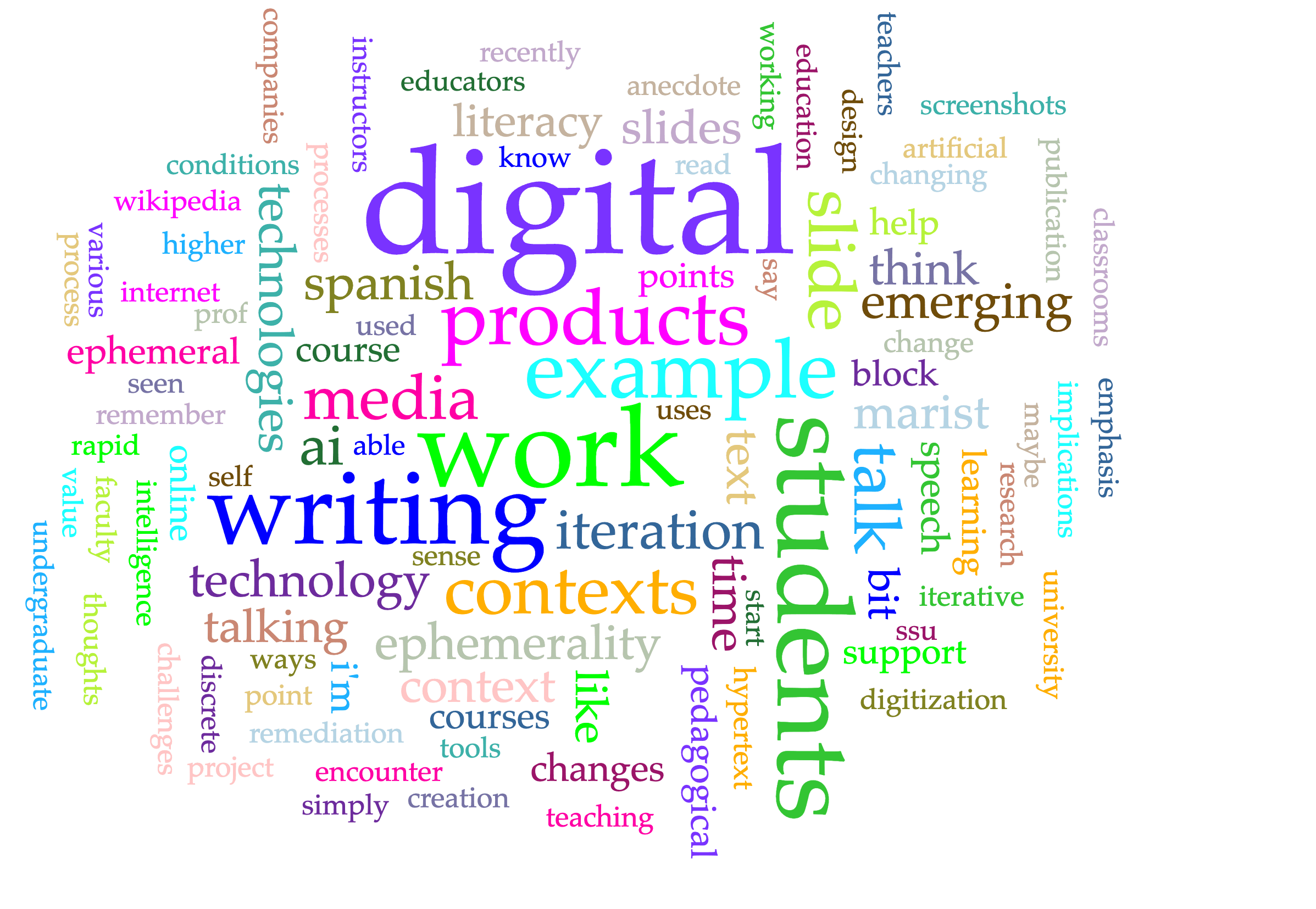
    Screenshot of a word cloud drawn from draft notes of this talk, created with Voyant

    A digital initiative involving the creation of a dataset may seem challenging to deploy in certain course contexts. But data literacy is a topic that resonates across our campus, whether in student-facing work explicitly tied to AI literacy, data implications related to course objectives, or the ways we are viewed and perceived as and through data in our personal and professional lives. Digital humanities practitioners have developed tools that can benefit in course contexts where you would like students to be exposed to core data and digital literacy concepts. I used to roll my eyes at slide decks that included word cloud visualizations. But I will say from experiences supporting undergraduate and graduate courses (and teaching my own) that open-access, web-based tools like Voyant can be great entry points to help students understand the implications of a world mediated by data.

    screenshot of a DocuViz visualization of a Google Doc’s edit history (specifically, the notes used to compose this talk)

    I also want to highlight DocuViz, a browser plugin created by Hana Research Lab at UC Irvine that allows users to visualize the edits made to Google Docs over time. Rather than using Google Doc version history to surveill students, I prefer approaches that make digital writing contexts like version history more transparent and accessible to students themselves, especially if these tools help students reflect on areas like time management, investments in revision, and collaborative writing dynamics.  

    I have worked with various instructors to develop lesson plans and assignments, occasionally visiting classrooms to facilitate or co-facilitate sessions too. Tools like Voyant and DocuViz are interactive and participatory opportunities for students to experiment with their own chosen texts and contexts, or to apply course discussions and models of data creation and analysis to selected course materials. While some prognosticators have emphasized the need to prioritize potential employees with explicit AI experience, I would argue that CTLs can shore up digital literacy expertise beyond this narrow, tool-based, product-entwined form of support. I’ve even used pen and paper and whiteboards to create small datasets and visualizations with students. This work is ultimately ephemeral but impactful.

    screenshot of a Microsoft Copilot chatbot question asking for an overview of The Louvre
    Screenshot of a Microsoft Copilot chatbot question requesting an overview of the Louvre Museum

    Some students (and colleagues) value the frictionless experience that AI chatbots like Microsoft Copilot seem to provide them. But these workflows create distance between users and the iterative and networked realities of knowledge and cultural production. Many chatbots have revised their interfaces to include citational materials, but these elements often obscure key contextual elements of how information changes and varies across time and space, choosing instead to amplify data mediated by search engine optimization methodologies, conditions of digital media that are not immediately clear in these clean and tidy outputs. 

    screenshot of slide including Wikipedia citations and edit history visualization of "Louvre Museum" page
    Wikipedia citations and edit history visualization of “Louvre Museum” page

    Wikipedia data has been an important component of many AI datasets due to its openness and scale. But AI has also revealed how important the design and interface of Wikipedia is to information literacy. While the sheer amount of hyperlinks and avenues of inquiry can be initially overwhelming to some users, Wikipedia (and the visualization and data-oriented tools developed by its community) can help students see debates around information and ideas over time, the implications of citing and relying on particular sources, how perceptions of value change over time, how a topic is described and contextualized in one language compared to another. Wikipedia is not a perfect resource due to concerns about bias and the authority of particular editors and citational sources, but it also reveals these tensions and discussions in its edit histories and forums, unlike chatbots.

    I’ll conclude with some of the questions I’ve been thinking about in light of these recent experiences. My hope is that the challenges of this particularly disruptive and still-iterating moment might lead to opportunities for CTLs and other forms of faculty and classroom support to reflect on the role that investments in digital literacy beyond AI might play in our missions, resource development, and expertise.

    • How do we critique and reject pedagogical responses that prioritize technological adoption and acceptance, forms of surveillance, idealizations of “rigor” (among other impulses) via an emphasis on “process” over “product” in the classroom?
    • How can educators use the iterative dimensions of digital media and emerging technologies to help students understand how cultural and knowledge production works (and changes over time) in their fields and in the institutions they reside in?
    • What questions do these approaches to digital literacy raise about how centers for teaching and learning (and other forms of faculty support) are best situated to support instructors, programs, and institutions (and their students)?

    Jim McGrath (he/him) is an Instructional Designer at Salem State University’s Center for Teaching Innovation. He can also be found on LinkedIn and Bluesky. Feel free to reach out if you have questions or comments!

  • “This is Fine”: Reading, Making, and Archiving Memes after November 2016 (NCPH Twitter Mini-Con, October 2018)

    Title slide for NCPH Twitter Mini-Con talk, featuring the infamous "This is fine" dog from K.C. Green's Gunshow comic
    this is fine

    On October 18th, 2018, I presented a talk as part of “(Re)Active Public History,” a Twitter Mini-Con put on by the National Council on Public History. Here’s the abstract I submitted for the conference (which you can also find here):

    A cartoon dog sits with a cup of coffee in a room that is engulfed in flames. “This is fine,” he says to no one in particular. These images, which originally appeared in K.C. Green’s webcomic Gunshow in 2013, have become a kind of shorthand for the mood in America after the 2016 election, an example of the ways that memes are increasingly relied upon by social media users to document their experiences in uncertain times. Social media encourages and profits from our impulses to document our present moods with image macros, reaction GIFs, screenshots, and other multimodal forms of expression. Memes have been remediated as protest signs at various marches, and it is increasingly common to see memes in political campaigns and in the Tweets of sitting senators. In July 2017, President Trump infamously circulated a meme in which he attacks a professional wrestler whose head has been digitally replaced by the CNN logo, an act of online speech that was interpreted by many as an endorsement of violent reprisals against journalists.

    Memes, in other words, are an undeniable part of contemporary American culture. This presentation will consider the roles memes have played in defining and subverting American political discourse in The Age of Trump. More generally, it considers where, how, and why public historians might read, historicize, preserve, and make memes about the American experience.

    (more…)
  • Hyperlocal Histories and Digital Collections (DLF Forum 2018 talk)

    This is a slightly extended version of a talk I presented at the Digital Library Federation 2018 Forum, held in Las Vegas in October 2018. Thanks to students in my Fall 2017 “Digital Public Humanities” course; the Providence Public Library Special Collections department; Diane O’Donoghue; Julieanne Fontana, Angela Feng, and Jasmine Chu; Monica Muñoz Martinez; Susan Smulyan; and the Rhode Tour project team for their contributions to my thinking and work on this topic. And thanks to Bethany Nowviskie for making DLF Forum a supportive space to consider these and other issues

    So, “hyperlocal histories.”

    (more…)
  • Media Literacy in The Age of Fake News and Big Data: Course Debrief and Reflections

    Students in my Media Literacy course looked at archival materials in the John Hay Library at Brown University.

    Earlier this month I taught a two-week course titled “Leadership and Media Literacy in The Age of Fake News and Big Data” for the Brown Leadership Institute. My first teaching job (way back in 2003!) was with a summer reading enrichment program for K-12 students, so it was fun to pick up teaching high school students again fifteen years (!) later. I wanted to reflect on some of the things I learned from this experience, since I know that some folks on Twitter seemed interested in the class. I’m not sharing the syllabus here because it has lots of “Leadership Institute” stuff in it that ties it pretty explicitly to the programs particular aims and pedagogical contexts. That being said, here are three major areas of inquiry for the course that I provided to parents, relatives, students, and my Leadership Institute colleagues at our session’s closing remarks:

    The history of media and the long history of Fake News: We started with an overview of “pre-digital” media and data contexts by inventorying and describing popular forms of media and the material conditions informing their use and reception. A major component of this work involved collaborating with and talking to local archivists: specifically, Heather Cole at the John Hay Library and María Victoria Fernández at the John Carter Brown Library. Heather was gracious enough to show students a wide assemblage of archival materials relevant to the course’s investments in propaganda, activism, and small and large sites of circulation. Together we looked at copies of The Black Panther newspaper and Marvel’s Black Panther comic book, LGBTQAI zines, anti-slavery almanacs, and early attempts to falsely attribute work to William Shakespeare (documents that came with what they claimed were literal locks of hair from The Bard’s head!). María introduced us to the various challenges that the JCB faces in digitizing and disseminating its materials online, attempts to connect primary texts held by elite institutions to highly-trafficked, networked, and more accessible resources like Wikipedia, and ongoing efforts to consider the roles digital tools and their users might play in efforts to decolonize archival spaces.

    We also discussed various attempts to misrepresent, falsify, deceive, or otherwise manipulate audiences in these pre-digital spaces (like the Shakespeare example), but to be honest we didn’t do as much of this as I’d originally planned (we discussed them in digital contexts). I’m halfway through Kevin Young’s Bunk and I think that book and other resources might give me some ideas if I revisit this topic.

    (more…)

  • Digital History Is More Than Just Sitting Behind Your Laptop

    Slide from my talk at Salem State, outlining major questions for consideration.
    Slide from my talk at Salem State, outlining major questions for consideration.

    Note: On March 26th, 2018, I had the privilege of giving a talk titled “Digital Humanities, Hyperlocal Histories, and Community Archives” at Salem State College. Thanks to Roopika Risam, Susan Edwards, and Salem State’s Digital Humanities Working Group for inviting me to campus. In my talk, I discussed recent collaborative work with graduate students in Brown’s Public Humanities program and community partners like the Providence Public Library Special Collections department: you can read about those efforts here. I also talked a bit about lessons learned from my work on Our Marathon: The Boston Bombing Digital Archive. I’ve circulated that portion of the talk below.

    For more information about Our Marathon, check out this recent publication (co-authored with Alicia Peaker), and this talk I gave at the American Studies Association conference a few years ago. If you’re in the Boston area, come to Northeastern on Monday, April 23 to “Storytelling, Archives, and Resilience,” a panel commemorating the five-year anniversary of the bombings (and announcing a relaunched Our Marathon project site).

    (more…)

  • On Collaborations with Archivists in Digital Public Humanities

    Archival materials in the Providence Public Library Special Collections room.

    In the Fall of 2017, I taught a graduate-level course in Digital Public Humanities for the second time here at Brown. The first iteration of this course, which I taught in the Spring of 2016, took a survey approach to digital humanities and DH contexts for Public Humanities. Students were invited to create speculative or “proof of concept” applications of our readings to public humanities contexts they were interested in exploring further. These student projects (which they described on the course’s blog) were extremely innovative and inventive, and they documented the class’ various interests in minimal computing, provenance metadata, augmented reality, and other topics. At the time I was pretty comfortable with both the survey model and an approach to student project development “ that clearly situated itself as the first step in an iterative, still-developing process.” For many students, this was their first DH class or their first time working with and thinking about digital tools and methodologies. It was also my first course in Public Humanities, so I wanted to learn more about student interests and expectations in our program.

    For this second iteration of Digital Public Humanities, I was interested in having students work with an external collaborator (something our program actively encourages instructors to consider when developing courses). Thankfully, I didn’t have to look far: as I was beginning to brainstorm, Jordan Goffin, Head Curator of Special Collections at the Providence Public Library, reached out to me (via Twitter: see, Twitter can be useful sometimes!) to see if I’d ever thought about collaborating with the PPL on a digital project. Some readers familiar with Brown’s resources may be surprised to learn that an archives-oriented Digital Public Humanities course here wasn’t collaborating with The John Hay Library, The John Carter Brown Library, The Haffenreffer Museum, or other more “local” resources on campus. These organizations are all thinking a lot about digital contexts for their materials, and they have in the past collaborated or consulted with our students and faculty on these (and other) topics. But beyond the fact that the PPL reached out to me, I was also ignorant about what materials it held in its Special Collections and curious to find out more. What I quickly learned was that the Providence Public Library had been thinking a LOT about digital spaces. More specifically, they were really interested in how these digital spaces informed and encouraged use of materials by local communities in Providence, as well as how digital contexts for archival materials might reflect the value of these materials by the communities represented in these collections.

    (more…)

  • Haunted Home Pages #2: The Garment District

    Garment District Halloween ad on The B Line (Green Line), October 2017.
    Garment District Halloween ad on Boston’s C Line (Green Line), October 2017.

    Welcome to Haunted Home Pages, a semi-regular series of blog posts in which Jim McGrath spends October 2017 communicating with the internet’s afterlife via The Internet Archive’s Wayback Machine . For all the posts in this series, click here.

    Boston has changed a lot since I moved here in 2003, but one thing has stayed fairly consistent: The Garment District in Cambridge has been a go-to source for Halloween costumes, and the ads it blankets the T with each year promoting its wares (and wears) are always instant time capsules for the year’s pop cultural touchstones, memes, and monsters. I thought it would be fun to take a tour through the shop’s home page over the years to see what we might learn from the ghosts and garments of Halloween Past!

    (more…)

  • Haunted Home Pages (#1): Stephen King

    The Official Stephen King Web Presence (2000)
    The Official Stephen King Web Presence (March 2000)

    Welcome to Haunted Home Pages, a semi-regular series of blog posts in which Jim McGrath spends October 2017 communicating with the internet’s afterlife via The Internet Archive’s Wayback Machine . For all the posts in this series, click here.

    I wanted to kick off Haunted Home Pages with a look back at The Master of Horror, Stephen King. I went through a huge King phase back in junior high and high school, and I will provide an embarrassing image of myself from this period to prove just how into King I was back then!

    Jim McGrath, Stephen King fan (Christmas 1996)

    The Wayback Machine has entries for stephenking.com stretching back to November of 1998, but this March 2000 cached page is the first one I found to provide a clear vision of the author’s “web presence.” We’re greeted with a static home page that visualizes the site’s architecture as a large circle with a smaller one devoted to “Links” orbiting it (half of the larger home planet of All Things King is dedicated to a timeline, while the other half covers a range of topics about the author).

    The section dedicated to “rumors” is disappointing to gossip hounds (like me) since it’s primarily about fan correspondence and autograph policies, though there is a question about an alleged haunted house run by King on Halloween (“this is not true and never has happened.”). “the man” is a biography of King (co-authored by Tabitha King, his wife) spread across a number of individual pages: each page has about a paragraph of text on it and includes a link to a printer-friendly version. There’s also a brief note about a 1999 appearance by King on Dateline that apparently led to fan concerns that the author was “unable to write”: this note isn’t clearly dated on the home page, which seems to aspire to the “endless present” of static home pages then and now.  King’s site in this incarnation was “designed, maintained, and hosted” by i-forge Design Factory, a company whose own home page from this period is sadly hidden from the Wayback Machine by robots.txt.

    THE PLANT, an unfinished serial narrative King began selling on his personal web site in 2000.
    THE PLANT, an unfinished serial narrative King began selling on his personal web site in 2000.

    The next major transformation of King’s personal web site comes in 2000, when the author decided to add a “downloads” section in order to sell The Plant, “an epistolary novel set in the 1980s (before email, in other words, and when even the fax was a fringe technology).” As the  project’s Wikipedia article notes, King would never complete the novel, but it was a fascinating experiment in self-publishing via electronic means, especially given the author’s stature and his commitment to transparency. You can read what was completed on The Plant, as well as commentary from King during and after this publishing experiment, on the current “live” version of the author’s site, free of charge.

    (more…)

  • “Our City”: Images of Home in Our Marathon, The Boston Bombing Digital Archive

    Source: Our Marathon
    Source: Our Marathon

    Note: The following post is adapted from remarks I gave at the 2016 American Studies Association Conference on a panel titled “Home Screens: Digitizing Belonging and Place in American Studies.” Thanks to my fellow presenters and attendees for their participation, to Alicia Peaker and the rest of the Our Marathon project team, and to Carrie Johnston for organizing the panel.

    In his remarks at an interfaith prayer service in Boston on April 18th, 2013, three days after the Boston Marathon bombings, President Barack Obama noted more than once to his audience that “Boston may be your hometown, but we claim it, too.” In the hours, days, and weeks following the events of April 15th, 2013, many people used social media to document how “at home” they feel or once felt in Boston.

    I’m interested in ideas of home and digital spaces in the context of Our Marathon: The Boston Bombing Digital Archive. Our Marathon, a community project hosted by Northeastern University, is a crowdsourced digital archive of close to ten thousand stories, photos, and social media about the 2013 Boston Marathon bombings and their aftermath. I started working on it as a graduate student research assistant in May of 2013, became Project Co-Director (with Alicia Peaker, now at Bryn Mawr) in the fall of that year, and I continue to work on it as we preserve our digital assets and make them more accessible in the short and long-term via Northeastern’s Digital Repository Service.

    Slide by Jim McGrath
    Slide by Jim McGrath

    I’m particularly interested in discussing Our Marathon and what it might tell us about home and digital regionalism, home and digital archives, and home and digital public humanities.

    (more…)