Tag: digital pedagogy

  • New Resource: Teaching In The Age of AI

    screenshot of the home page of "Teaching In The Age of AI," a Canvas resource site for Salem State University instructors. The home page includes an archival image of librarians working at early versions of computers

    I wanted to share a link to our Center for Teaching Innovation‘s new public-facing Canvas site, Teaching In The Age of AI. As you’ll see, the course has been published by me under a CC BY-NC-SA 4.0 license, so folks who can comply with those terms should feel free to keep that in mind!

    Some context that may be of interest to folks in Center for Teaching and Learning (CTL) spaces or faculty support sectors doing similar work:

    • This course came about as a result of conversations we are having about developing asynchronous resources for faculty on topics like AI, given busy/competing schedules and the impact of live programming; we still run live programming regularly and some resources here are taken from / revised from live programming contexts. 
    • We have noticed that while recordings are requested regularly by some faculty, our metrics indicate that video content is not watched by large numbers of our faculty community. We also are trying to be aware of the impact of recording on faculty participation, given AI discourse in and beyond higher ed and emerging literacies.
    • This course draws on faculty feedback from programming, consultations, organic outreach, colleague feedback, and a more formal review of an earlier iteration of this course by a small group of faculty (which we were able to provide small compensation for). And we have a survey for use by our faculty (so please do not complete it if you do see it when perusing!).
    • Noting that latter bit because you’ll likely notice that the content focuses on AI literacy, AI implications for course design, and AI implications for assessment. Within those areas, we have generally seen an interest in resources to help faculty steer students towards established methodologies related to reading, research, and writing (among other areas) in lieu of AI outsourcing. Academic integrity implications are also top-of-mind for many people here. We do have instructors who are doing more work related to AI workflow integrations and prototyping use-cases with students, but we have been supporting that work in other areas / contexts and we’re still considering campus-wide asynch resources (especially given the range of course contexts and use-cases across our campus).
    • We did get feedback from a few folks about a desire for multimodal resources, so a number of pages have suggested video / podcast content in addition to text and links. I will note that I tried to steer clear of resources created by AI companies whenever possible (and that this was a challenge at times).
    • We are also developing asynchronous content outside of Canvas and we may be considering what some of this content looks like when migrated to different online formats and spaces; this is kind of a pilot resource approach for us.
    • No AI was used in the creation of the course materials generated (sorry) by me. I have lightly experimented with AI in CTL content generation contexts here and there (not in the context of this project) but I have generally been dissatisfied with the output results and prefer the personal benefits of developing these resources via more traditional means. I have other personal views informing these methods too. Our office is also thinking about where and how AI usage is disclosed in CTL and course contexts, but that is a larger conversation and one we are just beginning over here.

    I’ll continue to share AI literacy-related resources here. Folks can feel free to email me or bug me on LinkedIn to talk more!

    Jim McGrath (he/him) is an Instructional Designer at Salem State University’s Center for Teaching Innovation. He can also be found on LinkedIn and Bluesky. Feel free to reach out if you have questions or comments!

  • Digital Processes, Not Products: Embracing Digital Ephemerality and Iteration

    Digital Processes, Not Products: Embracing Digital Ephemerality and Iteration

    Hi! Below you’ll find the text of a “PODTalk” I gave at the 2025 POD Network Conference in San Diego. This was my first time attending and presenting at POD and I really enjoyed my experience there. Thanks to CTI Director Eliza Bobek for allocating resources for this professional development opportunity, and thanks to my colleagues for their feedback and support.

    Some of the content below is also informed by a recent virtual presentation I gave with Keja Valens and two students at the 2025 Latin American and Caribbean Digital Humanities Symposium. Very grateful to Keja for being a terrific collaborator and colleague at Salem State. We both learned a ton from our student presenters and the rest of the students we’ve done cookbook data work alongside!

    Finally, just noting that the views expressed here may not reflect the sentiments of Salem State University or the views of my colleagues in SSU’s Center for Teaching Innovation.

    screenshot of an Internet Archive Wayback Machine capture of a 2003 digital annotation project of Jonathan Swift's "Baucis and Philemon" poem
    A 2003 undergraduate creative project from “Writing For The Internet” (Prof. Mark Morreale) by Jim and other students, digitally annotating Jonathan Swift’s “Baucis and Philemon” (Internet Archive screen captures; captures of student site accessible online via The Internet Archive’s Wayback Machine)


    During my senior year as an undergrad English major at Marist College (now Marist University!) in 2002-2003, I took courses with Prof. Mark Morreale that involved the creation and publication of various forms and genres of electronic writing. Using The Internet Archive’s Wayback Machine, I was able to recover segments of this work: a collaboratively-edited online edition of Jonathan Swift’s “Baucis and Philemon” is what you see screenshots of here. 

    screenshot of slide highlighting readings that informed Prof. Morreale's "Writing For The Internet" course, including: Hypertext 2.0 by George Landow; Hamlet on The Holodeck by Janet Murray; Remediation by Jay David Bolter and Richard Grusin; Radiant Textuality by Jerome McGann
    Screenshot of slide highlighting readings that informed Prof. Morreale’s “Writing For The Internet” course, including: Hypertext 2.0 by George Landow; Hamlet on The Holodeck by Janet Murray; Remediation by Jay David Bolter and Richard Grusin; Radiant Textuality by Jerome McGann

    The finished online products, then and now, were not particularly impressive. What I remember more from Prof. Morreale’s courses were the points of emphasis on process. For example, in his “Writing For The Internet” class, we toured the Marist library’s emerging digitization wing, learning about optical character recognition and its value. We read postmodern literature and brought those earlier texts into conversation with emerging hypertext fiction and academic perspectives on digital media. We remediated poems from page to screen and considered what was gained, lost, transformed, and obscured in digital writing and digitization work.

    We focused on emerging digital trends and technological innovations, but this work felt more exploratory and inquisitive than deferential to a feeling that these changes were inevitable or all-consuming. We considered the affordances and limitations of new technologies, the earlier technologies mediating and informing our prior perceptions of literature, reading, and writing, the labor and expertise involved in book editing, web design, and digitization, the iterative and networked dimensions of knowledge production.


    screenshot collecting several headlines related to AI's impact on higher education. Headlines include "AI can write better university assignments than students, report suggests"; "Alarmed by AI Chatbots, Universities Start Revampling How They Teach"; "What Will Determine AI's Impact on College Teaching? 5 Signs to Watch"; "Designing Assignments in the ChatGPT Era"
    Screenshot collecting several headlines related to AI’s impact on higher education. Headlines include “AI can write better university assignments than students, report suggests”; “Alarmed by AI Chatbots, Universities Start Revampling How They Teach”; “What Will Determine AI’s Impact on College Teaching? 5 Signs to Watch”; “Designing Assignments in the ChatGPT Era”

    “Writing For The Internet” is ancient history compared to our current moment in higher education, where we are navigating the ongoing disruption caused by accelerations in artificial intelligence and hypercapitalist desires to embed this technology everywhere so that it becomes impossible to extricate from daily life. But I start here because I think we can learn from the ways it introduced ideas of digital literacy to students via slower, deliberate work around digitization and born-digital materials, data creation and use, and the motivations behind these uses of technology. 

    screenshot of a quote from Matteo Pasquinelli's The Eye of The Master: A Social History of Artificial Intelligence. The quote reads ""...the operative principle of AI, in fact, is not just labour automation but also the imposition of social hierarchies of manual and mental labour through automation."
    “…the operative principle of AI, in fact, is not just labour automation but also the imposition of social hierarchies of manual and mental labor through automation.” Quote from Matteo Pasquinelli’s The Eye of The Master: A Social History of Artificial Intelligence (Verso Books, 2023)

    To be candid, I have grown increasingly concerned about our collective response to student perceptions of AI. I don’t view the outsourcing of classroom tasks to AI as indicative of a moral failing on the part of the students. The moral failings arise when institutional administrators claim that “AI is here to stay” without interrogating the motivations behind the managerial and corporate cultures that desire this interpretation of reality. Calls to reimagine higher education that retreat to pedagogical approaches which prioritize the authority of the instructor, surveillance mechanisms, management culture priorities, and discipline over discovery seem unconvincing, shortsighted, and a disservice to our professions and our students. 

    Screenshot of slide titled "Digital Processes and Digital Products in the Age of AI." The slide reads: 
Iteration is not Automation. We should interrogate the implications and limitations of tools marketing the benefits of automation to higher education.

We should prioritize "labor literacy" and labor implications when developing coursework and connecting that work to "workforce development" contexts.

What if we didn't view student tendencies to outsource coursework to AI tools as indicative of moral failings or shortcomings on their part, and instead reckoned with what these actions say about our approaches to teaching and learning?
    Screenshot of PODTalk presentation slide emphasizing iteration over automation, “labor literacy” over “workforce development,” and self-reflection on why students outsource coursework to AI. Transcription of slide is in the image alt text.

    Higher education can and should play a role in labor literacy and we should view AI and other technological innovations and use-cases through the lens of labor. We should not prioritize the financial benefits of automation when they are reaped by a small management class further consolidating its wealth. Perhaps the students we encounter skeptical of “busy work” who don’t feel ethically compromised by the outsourcing of coursework to generative AI tools might be convinced to behave differently if their instructors clearly showed them what might be gained from other courses of action. Perhaps we might encourage the use of our campus classrooms as sites where questions, concerns, and critiques about desired personal and professional use-cases of AI might be centered as elements of productive and necessary friction rather than viewed as obstacles, hyperbole, out of touch with “reality”. 

    Now I’ll talk a bit about some recent work related to digital project development, assignment design, and AI literacy  that I have taken up via my role at Salem State’s Center for Teaching Innovation. I try to prioritize low-lift, malleable examples due to the range of resources we all might possess: digital expertise, time, staffing, money. CTLs and other support sectors might use the specific context of AI’s impact to think more broadly about our investments in digital literacy and expertise in areas like staffing and professional development, approaches to programming and resource development, and opportunities to collaborate and iterate with departments, programs, and instructors. 

    screenshot of presentation slide titled "Process (or The Value of DH Methods in The Age of AI)". The slide text reads: 
What happens to cookbooks when they are remediated and reimagined as datasets?

What does the remediation of text into data encourage (reading across texts, recipe instructions, ingredients, advertisements) and obscure (material/print contexts, cultural/regional/temporary specificity, multilingualism/linguistic varieties)?

What approaches to project development, data creation, and analysis encourage digital literacies, collaboration, critical inquiry, iteration?
    Screenshot of presentation slide documenting questions related to digital humanities methodologies used in a cookbook dataset creation project. The questions emphasize the implications of turning text into data; what remediation encourages and obscures; what DH methods might encourage digital literacies and critical inquiry through iterative and collaborative means.

    For example, recently I had the pleasure of collaborating with Prof. Keja Valens in our English Department on a dataset creation project related to her interest in Caribbean cookbooks. We worked with a team of undergraduate researchers, introducing them to methodologies informed by digital humanities and ethnic studies. Students learned about the material, cultural, and social histories of various cookbooks, what we know and don’t know about recipes and their authors, what their ingredients tell us about transatlantic trade and the ways that colonial perspectives and power dynamics informed their creation and dissemination. They were also introduced to core concepts in data literacy: how datasets are created, organized, revised, visualized, analyzed, and disseminated by different researchers and audiences. 

    Some of this work could have been outsourced to generative AI tools But students reported that the time invested in tasks perceived by others as menial or even “mindless” data entry work felt integral to the project, in part due to the guidance, context, and opportunities for discussion and reflection we scaffolded around these activities. These experiences and sentiments also informed a Faculty Professional Learning Community I co-facilitated with English Department Chair Scott Nowka on Digital Ethnic Studies (funded in part by resources from the Digital Ethnic Futures Consortium), in hopes of further disseminating the value of this iterative work in data creation across campus. 

    Digital humanities methodologies might serve as useful counters and correctives to desires to prioritize AI outsourcing and integrations at the expense of pedagogy. Creating conditions of digital pedagogy that ask students to make, refine, and use datasets from primary sources like cookbooks can be done at various scales. Working with an emphasis on process as well as product can help students understand what is gained and lost from digital remediation, where spatial, cultural, linguistic, and historical contexts might be obscured or amplified via data creation and analysis, and why questions about audience, design, intended use, and ethical implications (among others) should inform the creation and use of digital tools and media in educational, professional, and personal contexts.

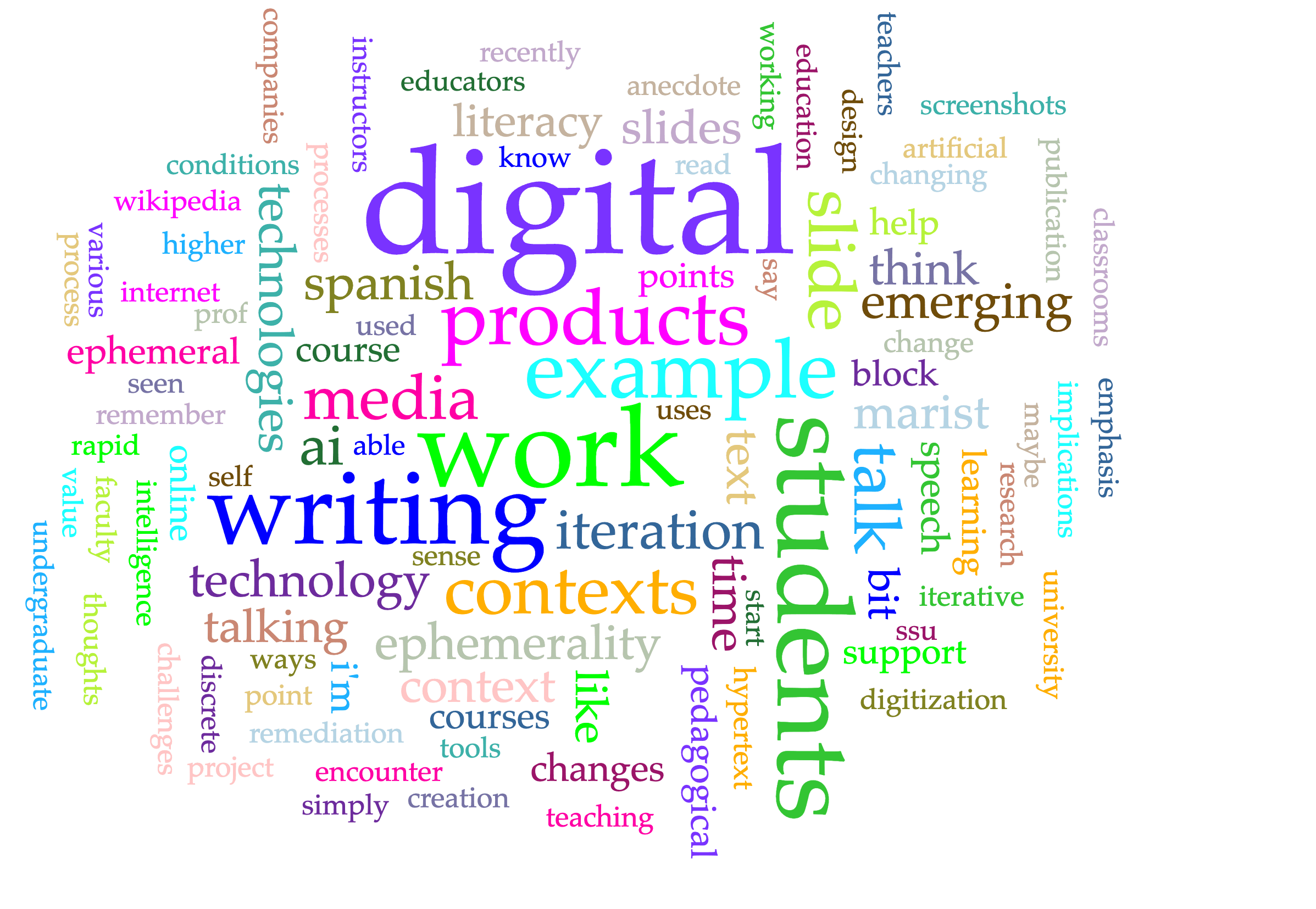
    Screenshot of a word cloud drawn from draft notes of this talk, created with Voyant

    A digital initiative involving the creation of a dataset may seem challenging to deploy in certain course contexts. But data literacy is a topic that resonates across our campus, whether in student-facing work explicitly tied to AI literacy, data implications related to course objectives, or the ways we are viewed and perceived as and through data in our personal and professional lives. Digital humanities practitioners have developed tools that can benefit in course contexts where you would like students to be exposed to core data and digital literacy concepts. I used to roll my eyes at slide decks that included word cloud visualizations. But I will say from experiences supporting undergraduate and graduate courses (and teaching my own) that open-access, web-based tools like Voyant can be great entry points to help students understand the implications of a world mediated by data.

    screenshot of a DocuViz visualization of a Google Doc’s edit history (specifically, the notes used to compose this talk)

    I also want to highlight DocuViz, a browser plugin created by Hana Research Lab at UC Irvine that allows users to visualize the edits made to Google Docs over time. Rather than using Google Doc version history to surveill students, I prefer approaches that make digital writing contexts like version history more transparent and accessible to students themselves, especially if these tools help students reflect on areas like time management, investments in revision, and collaborative writing dynamics.  

    I have worked with various instructors to develop lesson plans and assignments, occasionally visiting classrooms to facilitate or co-facilitate sessions too. Tools like Voyant and DocuViz are interactive and participatory opportunities for students to experiment with their own chosen texts and contexts, or to apply course discussions and models of data creation and analysis to selected course materials. While some prognosticators have emphasized the need to prioritize potential employees with explicit AI experience, I would argue that CTLs can shore up digital literacy expertise beyond this narrow, tool-based, product-entwined form of support. I’ve even used pen and paper and whiteboards to create small datasets and visualizations with students. This work is ultimately ephemeral but impactful.

    screenshot of a Microsoft Copilot chatbot question asking for an overview of The Louvre
    Screenshot of a Microsoft Copilot chatbot question requesting an overview of the Louvre Museum

    Some students (and colleagues) value the frictionless experience that AI chatbots like Microsoft Copilot seem to provide them. But these workflows create distance between users and the iterative and networked realities of knowledge and cultural production. Many chatbots have revised their interfaces to include citational materials, but these elements often obscure key contextual elements of how information changes and varies across time and space, choosing instead to amplify data mediated by search engine optimization methodologies, conditions of digital media that are not immediately clear in these clean and tidy outputs. 

    screenshot of slide including Wikipedia citations and edit history visualization of "Louvre Museum" page
    Wikipedia citations and edit history visualization of “Louvre Museum” page

    Wikipedia data has been an important component of many AI datasets due to its openness and scale. But AI has also revealed how important the design and interface of Wikipedia is to information literacy. While the sheer amount of hyperlinks and avenues of inquiry can be initially overwhelming to some users, Wikipedia (and the visualization and data-oriented tools developed by its community) can help students see debates around information and ideas over time, the implications of citing and relying on particular sources, how perceptions of value change over time, how a topic is described and contextualized in one language compared to another. Wikipedia is not a perfect resource due to concerns about bias and the authority of particular editors and citational sources, but it also reveals these tensions and discussions in its edit histories and forums, unlike chatbots.

    I’ll conclude with some of the questions I’ve been thinking about in light of these recent experiences. My hope is that the challenges of this particularly disruptive and still-iterating moment might lead to opportunities for CTLs and other forms of faculty and classroom support to reflect on the role that investments in digital literacy beyond AI might play in our missions, resource development, and expertise.

    • How do we critique and reject pedagogical responses that prioritize technological adoption and acceptance, forms of surveillance, idealizations of “rigor” (among other impulses) via an emphasis on “process” over “product” in the classroom?
    • How can educators use the iterative dimensions of digital media and emerging technologies to help students understand how cultural and knowledge production works (and changes over time) in their fields and in the institutions they reside in?
    • What questions do these approaches to digital literacy raise about how centers for teaching and learning (and other forms of faculty support) are best situated to support instructors, programs, and institutions (and their students)?

    Jim McGrath (he/him) is an Instructional Designer at Salem State University’s Center for Teaching Innovation. He can also be found on LinkedIn and Bluesky. Feel free to reach out if you have questions or comments!

  • ADAPT: A Generative AI Course Design Checklist

    Screenshot of ADAPT AI Course Readiness Checklist. The text reads:

ADAPT
AI Literacy Self-Assessment: What do you need to know about AI to design your next class?
Developing an AI Syllabus Statement: How will you apply what you have learned about AI to your course syllabus?
Aligning Assessment Activities with AI Policies: How will you apply what you have learned about AI to your course assessment activities?
Preparing Students to Understand AI Policies: What do your students need to know about AI and its impact on this course?
Trust, Transparency, and AI: How will you communicate with students about AI throughout the semester to help them succeed?

    As I’ve previously discussed on my blog, I am one of the nodes in the network of faculty, staff, and student support helping our campus community navigate the implications of AI on teaching and learning. Salem State University’s Center for Teaching Innovation continues to support folks throughout the summer, so as part of a “Summer @ CTI” June initiative I suggested a session that helped instructors who may be feeling overwhelmed by the wide range of tools, resources, and debates related to AI in higher education. We have previously used checklists in other professional development contexts, since they tend to work well as starting points that we can use to anchor live programming and then disseminate asynchronously to folks who can’t make live sessions.

    I came up with what we are calling ADAPT, a Generative AI Course Design Checklist.

    The bare-bones checklist you see at the top of this post is designed as a pared-down starting point, but it’s accompanied by additional questions for folks to consider as they review upcoming courses and plan relevant materials.

    Why ADAPT?

    • AI is a big and disruptive topic; it can be hard to know where to start in terms of course design
    • ADAPT is informed by SSU AI Advisory Group outreach and conversations re: immediate needs across classrooms here; soliciting feedback and perspectives across campus is an important component of resource development (and some of the concerns informing our checklist may align with your own)
    • For example, our office places a strong emphasis on the value of “AI literacy” rather than “AI evangelism”; many of our students, faculty, and staff wish to know more about this topic but also have concerns related to climate impact, copyright, misinformation, bias (among others)
    • ADAPT is a framework to get started and a recommended approach; it’s designed to help instructors self-assess their emerging AI literacies and plan next steps related to their more immediate course design priorities

    AI Literacy

    “AI Literacy” is a frequently deployed phrase in teaching and learning contexts, but it can be helpful to consider more specifically what “AI literacy” might entail.

    For example, in reviewing resources on this topic, I came across a 2024 framework developed by Michelle Kassoria, Maya Georgieva, and Allison Papini published by EDUCAUSE:

    AI literacy framework shared in linked EDUCAUSE article. The image is of a quadrant with four core areas: Technical (Understanding the fundamentals of how AI works); Practical (The application, integration, and implementation of AI tools in teaching, scholarship, and the management of educational priorities); Evaluative (Critically evaluating the application and output of AI tools by developing AI impact assessment tools); Ethical (Maintaining vigilance in development of institutional strategies in protecting against bias, misuse, and misapplication of these powerful models).

    I found these four areas to be helpful, but in talking with our faculty I decided to rephrase them into more colloquial language (while also sharing their point of origin) and de-emphasize certain elements (for example, many of our faculty are still weighing the benefits of application, integration, and implementation):

    • Technical: What are large language models? What are chatbots? What are hallucinations? 
    • Evaluative: Can we slow down and test some of this stuff out more? Do I have an idea for what I’d like to test, and why?
    • Practical: Am I OK with students using some of these tools in specific course contexts? What do they need to know? Who else is using this stuff in their classrooms?
    • Ethical: Should I be using this stuff myself? Should I have information to share with students about what not to do?

    More specifically, I shared some particular contexts and lines of inquiry that we have found helpful in our own emerging AI literacy work:

    • Moving from “AI” in the abstract to considerations of specific AI tools and use-cases in our classrooms and fields
    • Identifying “ethical implications” in specific contexts and in relation to core community values (for example, SSU’s HSI-MSI status)
    • Developing learning outcomes that address the impact of AI tools and use-cases by students, faculty, and staff
    • Reviewing specific implications for higher ed (teaching, assessment, emerging K-12 classroom AI use-cases)
    • Accepting that “AI literacy” is ongoing and what it entails will change as new tools, use-cases, and perceptions continue to emerge and change

    What might AI literacy look like across campus and beyond an individual course? I shared some suggestions and ideas and referenced some ongoing work we are involved with here at the CTI, including:

    • Assessment of AI syllabus language and course policies
    • AI’s impact on student support/student success work
    • AI and Academic Integrity resources for faculty, staff, and students that prioritize equity, encourage AI literacy, assess impact on research/writing
    • Department-specific support and dialogue on AI’s impact
    • AI’s impact on student professional development/experiential learning
    • Transparency and piloting in potential administrative uses of AI

    AI and Assessment Design/Redesign

    In introducing ADAPT, we spent a bit of time discussing the particular challenges instructors face regarding assessment design.

    We started with a consideration of framings that recommend “AI-proof” or “AI-resistant” assessment activities, with the following points of emphasis:

    • “AI-Proof” language may be useful when searching for assignments to model, but most assignments can be completed/aided by generative AI tools accessible to students.
    • “AI-Resistant” assignment recommendations acknowledge this reality. That being said, consider whether your assignment is “AI-Resistant” at the expense of teaching and learning.
    • For example, consider the negative pedagogical implications of handwritten major assessment activities, surveillance technology, and onerous submission guidelines on student success.
    • If an AI tool can be used by a student to outsource and complete an assignment, that doesn’t necessarily mean that you shouldn’t assign that assessment activity! But you may want to be transparent and direct with students about these possibilities, their limitations, and their impact on learning

    I shared some general recommendations with instructors about assessment after AI:

    • Start by explaining the value of completing this assignment within your desired parameters (with or without AI). Encourage questions.
    • Scaffolded assignments that use small assessment activities/in-class work may discourage some AI usage beyond your course policies; the value of working iteratively/incrementally should be made clear to students.
    • Some instructors have increased usage of archival materials/special collections and field work/experiential learning productively.
    • Some instructors have used multimodal/presentation outputs productively.
    • Rubrics that anticipate the quality/tendencies of AI outputs may also discourage some AI usage beyond course policies.

    I also noted that instructors who have encouraged or modeled use of AI tools in assessment activities tend to:

    • Emphasize use of specific, vetted tools (at SSU, instructors and students can access Copilot/Gemini licenses that have been vetted by our ITS department for use)
    • Identify specific points in assignment workflows to introduce/consider AI tools (brainstorming, copyediting, code review, audience/genre activities)
    • Model genres/use-cases from specific professional contexts relevant to the course
    • Incorporate AI tools in smaller assessment or ungraded assessment activities
    • Incorporate self-reflection requirements to help students assess the experience of using AI

    For interested faculty, I also suggested a self-assessment approach for assessment activities that may be impacted by AI use-cases:

    • Use SSU’s Copilot or Gemini accounts (or your own vetted AI tools) to gauge what an AI output generated by a student might look like.
    • Reflect on the quality (or lack of quality) of the output. How would you discuss this use-case with students? What is lost from outsourcing this work to AI?
    • What might be gained from incorporating AI into some component of the current assignment or a revised assignment? How would you discuss this use-case with students? Why might you still refrain from allowing this use-case?
    • How would a current or revised rubric help you assess this assignment and guide students towards what they should prioritize in this work?
    • How might you revise this activity and still maintain the course outcomes associated with it?

    Next Steps

    ADAPT was introduced in a 90-minute virtual workshop (attended by around 20 or so instructors and staff). Attendees were compensated for their attendance. Before the session, they were asked to have a syllabus (or notes for a new course) in mind, as well as at least one major assessment activity. They were also asked to send an informal follow-up message (around 250 words in length) via email to reflect on the workshop and identify/discuss relevant areas of interest and concern.

    The ADAPT checklist was designed to function as an asynchronous resource due to available time for professional development, instructor preferences, and to acknowledge that it is summer and folks may have other priorities. But we do really see it as a starting point that will ideally lead to additional conversations and discussions with faculty support sectors like CTI and with department/cross-campus colleagues.

    ADAPT is one of several support initiatives we are providing to our faculty to help navigate the implications of AI. I’ll try to share other work and efforts if they seem useful in contexts beyond our own institution.

    As I note in the checklist document, I am happy to talk more. I am sharing more of my AI work here because I have been encouraged to do so by colleagues and because I am hoping to model some AI literacy efforts that do not begin or end with AI adoption as an inevitability.

    Note: The views expressed in this post may not be shared by my employer or all of my colleagues and should not be regarded as an institutional or departmental perspective. If you’d like to talk more, feel free to email me at jimmcgrath[dot]us[at]gmail

  • Project Endings and Precarious Labor

    In April 2021 I was asked to participate in a virtual symposium hosted by The Endings Project, a grant-funded initiative interested in “creating tools, principles, policies and recommendations for digital scholarship practitioners to create accessible, stable, long-lasting resources in the humanities.” One of the big questions driving The Endings Project was, as you may have guessed, “endings” in the context of digital initiatives: how to prepare for their inevitability, what to preserve (and where, and how), and what a focus on endings might reveal regarding digital scholarship’s priorities and methodologies.

    Many of the presenters of the symposium contributed their perspectives to a 2023 Special Issue of Digital Humanities Quarterly called “Project Resiliency.” I was also invited to contribute to this special issue. I ultimately chose to withdraw my submission during the review process.

    As a precarious laborer in higher ed whose time is not explicitly compensated for academic writing like journal articles, I have to be selective and particular about the time and labor I devote to such endeavors. Unfortunately, the revision timeline for revision and final submission did not align with my schedule, and I was unwilling to sacrifice more personal time to meet this timeline. There were complications that were avoidable, like some confusion on my end about the DHQ article submission process for a special issue. But I also came down with COVID at some point in the editorial process. I also had some issues with the tone and explication of some of the reviewer feedback I received during the process (though I did receive useful feedback from one reviewer and from some members of the Endings Project team).

    I have previously withdrawn articles for consideration on the basis of what I view as uncharitable peer review feedback, or due to publication and revision timelines seeming unfavorable to work-life balance priorities, or just due to the unpaid labor not being worth the time or the effort. I remain interested in writing about my research interests and academic experiences for academic audiences, but I have grown picky about taking up that work in recent years. I wouldn’t rule out publishing with an academic publication like DHQ in the future: I have enjoyed writing for them and working with their editorial team in prior professional contexts.

    I do think it’s helpful to have the perspective of precarious labor in conversations around digital projects and endings, especially given that the contributions of precarious labor may not always be immediately visible in institutional records and archives. So hopefully some of what is written below is of interest to folks doing digital project work, in digital humanities or in other academic or non-academic contexts. I remain grateful to the folks on The Endings Project who thought of me for inclusion in the symposium, and I learned a lot from my peers in those conversations.

    Ultimately, my only regret was leaving the second polished draft of the article to rot in the dark in a Google Drive folder. Aside from some light copyediting and formatting, I haven’t substantially revised the text below. Under different circumstances, I would have likely revised and tweaked the piece below. But I’m ready to mark the end of this particular writing project and move on to other things.


    Project Endings and Precarious Labor

    December 2021

    The conditions of labor in higher education make it challenging for many digital humanists to take up project work if they reside outside of tenure-track and tenured hiring lines. I often think about all the exciting digital projects that never came to be because the conditions of academic labor made this work difficult if not impossible for people who occupy positions of precarious labor in higher ed: students, adjuncts, postdocs and recipients of other short-term fellowships, contractors and grant-funded collaborators, among others. For graduate students, they may only have a finite amount of funding from a fixed degree timeline, giving them little flexibility if a project’s timeline gets delayed or its scope gets assessed.  An adjunct may find it challenging to develop projects with little financial motivation, university support, or available hours in the day as they juggle and prioritize other work. A postdoc may not see the value in pursuing grant funding for a project that may extend beyond their fellowship (and organizations reading applications may question whether a postdoc will have reliable access to the resources needed to successfully complete a project)  An anticipated round of funding may fail to materialize if a grant application is rejected. A university may respond to a pandemic with a hiring freeze that leaves its postdoctoral fellows and adjuncts unemployed. It is difficult to plan multi-year initiatives, pursue grants, and devote the time, labor, and care needed to creating and sustaining collaborations if you are uncertain about your job prospects in the coming year or semester.       

    As of yet there is not much data on the scale and scope of the contributions that precarious labor makes to digital humanities projects. That being said, I have experienced the challenges of doing this work firsthand, and I have met many peers working within similar constraints who have shared concerning firsthand accounts. In September of 2018 I joined colleagues in the American Studies Association’s Digital Humanities Caucus to co-author a piece on “Precarious Labor and the Digital Humanities.” We were motivated to make the experiences of precarious labor more visible in large part because we had all at various points found that “the value of our labor has been challenged, taken for granted, dismissed outright, or explained away as at best a fad or at worst the manifestation of neoliberalism in its most craven form within the humanities” (Boyles et al., 2018). We noted the “significant barriers” some of us and our peers faced via the “high cost” of attending digital humanities summer institutes, and the challenges that postdocs and visiting assistant professors encountered when these positions were little more than “a way to fill gaps in programming or sustain curricular diversity without committing to a worker’s future prospects” (Boyles et al., 2018). Recipients of postdoctoral fellowships have been particularly vocal about “exploitative, extractive, dead-end positions” and their impact (Alpert-Abrams et al., 2019). It is perhaps telling that the core co-authors of “The Postdoctoral Laborers’ Bill of Rights” were primarily postdocs doing work in and around digital humanities, and that digital humanities is specifically mentioned as a space where precarious labor has “gone wrong” (Alpert-Abrams, et al., 2019).

    Many people occupying various positions of precarity do end up working on digital humanities projects, navigating these poor conditions while also calling attention to the need for substantial reforms in public writing or in more private dialogue (where possible) at local institutions. Over the last decade I have worked on digital initiatives as a doctoral candidate, a postdoctoral fellow, and an adjunct professor.  This article will reflect on my experiences as a project leader and collaborator on digital initiatives at Northeastern University and Brown University in the United States. I will discuss how conditions of precarity shaped the conditions of possibility on these projects: their scale, ambitions, and long-term preservation, among other factors. I will document where and how contributions from precarious collaborators were described and amplified, often out of necessity due to tendencies to privilege tenured and tenure-track faculty contributions at the expense of other participants. And I will reflect on alternate possibilities and actions that might be taken to improve conditions of digital labor, to prioritize long-term preservation without forgetting the precarious labor that saw these projects to completion, and to consider what happens when best practices in project endings privilege institutions over the needs, interests, and values of precarious labor.

    Our Marathon and Graduate Student Labor

    In the Spring of 2013, I was hired as a researcher on Our Marathon: The Boston Bombing Digital Archive, a community project that collected stories, images, and other materials related to the 2013 Boston Marathon bombings and their aftermath (McGrath et al., 2013-2015). The April 15th bombings at the finish line of the Boston Marathon was classified as an act of domestic terrorism, resulting in three deaths in the bombings, hundreds of injuries, and a citywide manhunt initated that put Boston on “lockdown” after the suspects engaged in several exchanges of gunfire with local law enforcement across the city.  Our Marathon was initiated by Elizabeth Maddock Dillon and Ryan Cordell, two faculty members in Northeastern University’s English Department. Dillon and Cordell led a team of graduate researchers in the early development of the project and were instrumental in securing internal and external funding lines for project labor and other resources. In anticipation of busier fall and spring semesters when other obligations and professional priorities would compete for their own time and attention, Dillon and Cordell successfully allocated the necessary funds and permissions to hire myself and Alicia Peaker as Project Co-Directors.

    Our Marathon was a rapid response collecting initiative, an attempt to centralize and preserve digital and digitized media about a contemporary event before the more ephemeral material disappeared or became more difficult to surface. The project also encouraged contributors to create new records describing and reflecting on the impact of these tragic events: photographs, artwork, oral histories, written testimonials. We were interested in documenting particular experiences (runners, first responders, survivors) and places (the Boylston Street finish line, the temporary memorial created and maintained in Copley Square), that seemed particularly valuable to the historical record and of interest to our desired contemporary audiences. But we also used the phrase “No Story Is Too Small” to encourage contributions that presented the lived experiences of these events and their reach from a variety of perspectives.

    Our Marathon’s ability to live up to this rhetoric was shaped and arguably constrained by our available funding and labor, as well as the newness of this kind of project to the institutional culture at the university. In 2013 Northeastern was still in the process of establishing and investing in the institutional support, staffing, and resources it would go on to utilize as an emerging hotbed of digital humanities scholarship and project activity. The Digital Scholarship Group, an integral hub providing support and expertise to a wide range of initiatives, had not yet been established at the Northeastern University Library when Our Marathon began to take shape. Graduate students in Northeastern’s English Department had traditionally secured funding from the university (when available) through teaching appointments, staffing roles at the Writing Center, or via fellowships or research assistantships, not digital project work. Northeastern’s library and its Archives and Special Collections department had previously encouraged students, faculty, and local community partners to deposit collections materials, but it had not previously supported a crowdsourced digital archival initiative that sought to publish and share collections material as it was added to a live, public-facing website.

    One constraint that quickly materialized for Our Marathon was its project lifespan. While Peaker and I were funded as Project Co-Directors, it was made clear to us that this funding would run out after the Spring 2014 semester. Our project budget would cover graduate researchers, and we were able to hire undergraduate work-study students during this time period for project labor. We were also awarded external funding from WBUR to compensate two oral historians (Jayne Guberman and Joanna Shea O’Brien), an audio technician (Ryan McDonough, then an MLIS candidate at Simmons University), and an oral history project manager (Kristi Girdharry, then a doctoral candidate in Northeastern’s English Department). We eventually secured some additional funding for the summer of 2014 to hire a team of graduate students to create metadata records for items shared with Our Marathon by the Boston City Archives. But active project work in the form of outreach, programming, the hiring and management of undergraduate and graduate staffing, and the updating of the project’s public-facing website concluded by August 2014.

    A year is a very tight timeline for a digital project, especially one with Our Marathon’s interests and lofty ambitions. Our efforts were aided in part by our reliance on Omeka, an open-source content management system that enabled us to quickly organize and publish digital items and collections on a public-facing website. Omeka enabled project team members to create and display metadata records for contributed items. For crowdsourced contributions received via our online portal or at our “Share Your Story” programming initiatives, we made use of a customized contribution plugin (developed by Becky Ferris, a freelance developer compensated for this work out of project funding) that presented users with a short series of questions designed to solicit metadata about materials and contributors.

    Omeka was essential to Our Marathon’s ability to solicit and quickly publish content, collections, and digital exhibits, but I would caution similar projects with short project lifespans, limited budgets, and precarious labor about the limitations of this content management system. An Omeka instance can be quickly installed and made public on a server if a project team has access to one, and Omeka also provides a service called Omeka.net where users can work with a “hosted service option” that is designed to alleviate “worrying about installation or hosting” (Omeka). But speed of publication can come with a cost if a project lacks the staffing or funding to devote time and resources to customizing their Omeka instance to align with the expectations of their project’s desired audience. For example, our use of Omeka on Our Marathon enabled us to easily collect individual crowdsourced submissions online or at our events, but our audience had to individually submit each item. While we worked individually with contributors who wanted to share multiple records, we no doubt lost contributions from users frustrated by these limitations. And while we paid a developer to customize the look and design of our Omeka instance to align it more closely with the aesthetics of contemporary websites, the interface, search engine limitations, and metadata-centric layout of item pages likely impacted the reception of the project among individuals more accustomed to the design choices and options presented by social media apps and multimodal collections hubs. So while Our Marathon would not have been possible without Omeka, our interest in speed and the limits of our budget likely limited the kinds of contributions we ultimately received on the project.

    Our concerns about these technical limitations and their impact on the stories present and absent in our crowdsourced collections led us to develop substantial programming that got us off Northeastern’s campus and into various neighborhoods and communities in Greater Boston. In the fall of 2013, we presented our project’s aims and intentions to a group of representatives of local cultural institutions in the area, along with a pitch offering to bring “Share Your Story” events to interested parties. Several institutions took us up on this offer, including the Watertown Free Public Library, which was interested in creating opportunities for its constituents to reflect on the impact of the shootout and ensuing manhunt for the bombing suspects that overwhelmed the city and its streets in April 2013. We also ran a series of events at the Boston Public Library’s main branch in Copley Square (located mere yards from the Marathon finish line and the site of the bombings), coinciding with the one-year anniversary of the bombings and the debut of a “Dear Boston” exhibition that displayed physical materials and photographs. Bringing “Share Your Story” events to public libraries helped us reach audiences who may not have come across Our Marathon by other means.

    These “Share Your Story” events became opportunities to increase archival literacy in conversations with attendees, as we frequently received questions about the perceived value of particular contributions and perspectives, the labor involved in taking up this work, and the role metadata plays in the creation and dissemination of collections, among other topics. Their success was also dependent upon our project team’s willingness to contribute unpaid time and labor to the project. Our ambitious Spring 2014 programming slate required a particularly large amount of additional hours that exceeded the hours we could bill for project work. Our team contributed this time and labor in part because we cared so much about the project’s positive impact and its value to the audiences we met beyond our department offices and laptop screens. But I imagine that we also undervalued our labor because of the culture of our profession and its investments in forms of exploitation. We also benefited from the relative newness of digital public humanities initiatives at Northeastern and the autonomy we had to shape the project and make decisions about its priorities. Our Primary Investigators graciously trusted our developing experience and our instincts.

    In many respects, Our Marathon quickly became a case study for Northeastern in terms of how it might support and encourage collaborative digital initiatives, and its approaches to project labor, management, documentation, and preservation would go on to influence the forms of project support offered by the Digital Scholarship Group (DSG) and Archives and Special Collections. For example, since 2015 the Digital Scholarship Group has offered the CERES Exhibit Toolkit, an initiative that provides pre-approved collaborators (via an application process) with resources and a workflow that enables projects to store digital collections in Northeastern’s Digital Repository Service (DRS) and curate and contextualize these materials for intended audiences via WordPress exhibit templates. CERES was inspired in part by Our Marathon and a growing interest in developing similar projects that desired to collect and archive materials as well as present project assets in a manner more engaging than a digital repository collections interface. WordPress was identified as a content management system that provided users with “design options” that gave their projects a desired look and feel more in line with contemporary websites than the themes offered by Omeka, while also “giving the DSG the standardization [needed] to ensure functionality in the future” (CERES 2019).  CERES also encourages the use of Northeastern’s DRS and its approach to metadata over the utilization of a content management system like Omeka, which uses Dublin Core standards. Our Marathon’s project assets were stored on library servers before content was successfully migrated to the DRS and published in a CERES WordPress incarnation in 2018, the five-year anniversary of the bombings. Several people involved in Our Marathon work were involved in the early development of the CERES Exhibit Toolkit, including myself.

    Giving Our Marathon a proper ending required additional investments in time, labor, and resources by Northeastern beyond the August 2014 end of active project development and outreach. The term “sunsetting” has been deployed at times to describe a project moving from an active initiative maintained by a core team and attendant support staff at institutions (like, for example, library staff checking on updates to project software and security risks, among other areas) to a state where the project’s core assets have been archived (or, in some cases, abandoned due to an inability to preserve due to technical, staffing, or economic limitations). But to watch a sunset is a passive act, while “sunsetting” often entails lots of time and work. So let’s call what happened with Our Marathon the conscious creation of conditions of a project’s ending, for the sake of clarity.

    While I stayed on at Northeastern to finish my doctorate and ended up hired by the DSG as a Coordinator due in part to my experiences on Our Marathon, Peaker graduated in late 2014 and the additional graduate and undergraduate labor on the project shifted their focus to degree obligations once project funding for staffing ran out. Because we knew that our time on the project was limited, Peaker and I reached out to Archives and Special Collections early in the project’s lifespan to discuss what they would need to archive and preserve materials in the DRS. Giordana Mecagni in Archives and Patrick Yott, Amanda Rust, and Sarah Sweeney in Northeastern University were integral in ensuring that Our Marathon invested early in the creation and use of a project metadata schema and project documentation. These people were also closely involved in the development of CERES and were key in enabling Our Marathon’s migration of assets and ending as a project under the CERES umbrella.

    In addition to documenting the motivations and justifications behind certain project decisions and leaving behind clear and accessible records regarding project data and materials, Peaker and I became particularly invested in documenting the contributions made by our various forms of project labor, given that our time at the institution was finite and that we and our collaborators desired the creation of a permanent and accurate record of our efforts. We had also previously found that, despite the efforts of Dillon and Cordell to center and document the contributions of graduate labor, media coverage of Our Marathon tended to focus on the faculty. For example, a Chronicle of Higher Education article on the project used a photograph of myself at one of our “Share Your Story” events but never mentioned my name or my role as Co-Director (Howard 2013).

    A revised Our Marathon project website launched in April of 2018. While our budgeting had allocated a small work stipend for my continued involvement on Our Marathon after August of 2014, I primarily volunteered my time and labor to serve as a resource to the DSG and Archives and Special Collections as they migrated project materials and created the new site. The revised Our Marathon site takes advantage of the CERES WordPress shell and the more powerful DRS search engine to present project assets in a clear and compelling manner. The Site Migration and Relaunch Team dedicated themselves to documenting previous contexts and contributions to the project’s history of staffing, as well as recording their own important contributions. The “Our Marathon 2.0” site provides a lengthy list of project alumni, a timeline of key project milestones, and a record of the project’s original use of Omeka.

    Since Our Marathon, Northeastern has played host to a number of digital projects and initiatives that centralize the publication and use of digital collections. Like Our Marathon, several of these projects involve off-campus collaborations. For example, Boston’s Racial Equity History Project is an effort involving Archives and Special Collections as well as the City of Boston’s Mayor’s Office of Resilience and Racial Equity and The Harvard-Mellon Urban Initiative. In 2018, the DSG began work on the Boston Research Center, a collaboration designed to support several projects connecting archival records of early and developing histories of Greater Boston to academic and nonacademic audiences. Graduate student labor remains an important component of these efforts. That being said, Our Marathon remains a kind of outlier due to the sizable project roles and influence that graduate labor had in shaping the direction of the initiative and documenting its precarious contributors.

    Project Fatigue: Learning The Wrong Lessons About Endings and Precarious Labor

    I have continued to work on digital public humanities projects since Our Marathon. Most recently, I was Public Humanities Lead on the Rhode Island COVID-19 Archive, a collaboration led by Kate Wells at the Providence Public Library’s Archive and Special Collections department and Becca Bender from the Rhode Island Historical Society. As with Our Marathon, Omeka enabled a team of collaborators who either volunteered time or had very small amounts of paid staff time (5 hours per week out of a 40-hour work week in some instances, for example) to quickly create a website that could solicit contributions, create item and collection metadata, and organize submissions into collections. But unlike Our Marathon, the Rhode Island COVID-19 Archive gathered larger collections of materials via targeted outreach that often involved contributors sharing files and contextual data via Google Drive folders, Google Forms, and Google Sheets. This content would then have to be migrated over to the project’s Omeka instance by project team members using Omeka’s CSV Import Tool and other resources. Because our team was made up of previous Omeka users like myself as well as trained archivists like Wells, Bender, and others, we were able to navigate the limitations of our project’s funding, staffing, and web design expertise. Jeremy Ferris, Providence Public Library’s Digital Content Manager, worked with Dana Signe K. Munroe, Registrar at the Rhode Island Historical Society, to make design choices that worked well within the limitations of Omeka’s built-in themes.

    The Rhode Island COVID-19 Archive has ended up collecting over 1500 submissions (as of this writing), and the project won the Rhode Island Council for the Humanities 2021 Innovation in The Humanities Award. Our Marathon was also an award-winning initiative, winning the 2013 Digital Humanities Award (an award given to candidates who receive the most votes from visitors to the DH Awards website) for “Best DH Project for Public Audiences.” These commendations were useful forms of validation and recognition that project team members could use in job materials and in making the case for future collaborative efforts in digital public humanities. But I am struck by how little has changed between 2013 and 2021, in terms of the lack of permanent or more stable lines of employment, financial resources, and time afforded these kinds of projects and their architects. There seems to be a clear disconnect between the value institutions receive from hosting these award-winning projects and the value assigned to the people responsible for their labor. I worry that projects like Our Marathon and the Rhode Island COVID-19 Archive demonstrate that these efforts can succeed in spite of the absence of more tangible and sustainable resources. And I do caution graduate students and early career scholars from getting involved in similar projects, in large part because they tend to exploit their precarious laborers even when staffed by team members who are aware of these contexts. In many ways these projects are labors of love, but such an approach is arguably both unethical and unsustainable.

    I have come to experience what I have begun calling “project fatigue” in the specific contexts of digital humanities, public humanities, and public history, after spending the last eight years working in and around these academic terrains and initiating or collaborating upon several projects. “Project fatigue” has been an unpopular term in some of these spaces, particularly when I have used it in reflections where I have hoped to think critically about the professional development of graduate students interested in digital humanities and digital public history. There are many examples of graduate students with digital project portfolios who have gone on to experience great success in higher education or in “alt-ac” careers, I am told. As someone who has at times been held up as one such example, having been awarded a Postdoctoral Fellow in Digital Public Humanities at Brown University after completing my doctorate in English at Northeastern University, I have a few asterisks and wrinkles to add to some of these digital project success stories.

    To be blunt, I think these narratives are often more emphasized by project collaborators with the comfort of long-term job security, by the institutions and departments looking to entice new graduate student applicants, and by earlier waves of digital humanists who, if they were graduating in the last five or six years, would be navigating job markets with fewer long-term positions and more “competition” in the rising numbers of early-career scholars with similar sets of interests and expertise. One’s perception of project endings – their necessity, their protocols, their investments in archiving and preserving long-term assets for re-use – is perhaps contingent upon one’s institutional vantage point, and in the ability to dictate the terms of an ending rather than have those conditions be dictated to you.

    When I reference “project fatigue” I am not suggesting that digital humanities practitioners stop initiating and collaborating on these kinds of efforts. But I do think that the precarity of some potential, desired, or even essential contributors to digital projects should be more explicitly acknowledged. Here are some areas where I have aspired to address conditions of precarity in the development, management, and endings of digital humanities projects:

    Contributor Roles and Responsibilities

    Job titles are an important component of digital initiatives, especially when the time and labor investments of precarious project team members are motivated by professional development and informed by time constraints like available staffing hours or undergraduate, graduate, and postdoctoral funding timelines. Job titles are also important elements of projects that the caretakers of projects and their endings should include in documentation and preservation materials. When discussing with students the ways that online content is not simply changing but also eroding, (digitally) rotting, and disappearing, I often ask them to read “All My Blogs are Dead,” a 2015 blog post by Carter Maness that describes the loss of clippings many online journalists have been forced to navigate when publications they once wrote for go out of business, get sold, or simply neglect to care for their archives. Despite years of experience, Maness came to find, when it came time to apply for new opportunities, that “my writing resume is now oddly incomplete and unverifiable” (Maness 2015).

    All laborers on digital projects, precarious or otherwise, should have a clear sense of where and how their contributions will be documented, as well as how that documentation will be preserved and maintained. In an ideal scenario, a project may have institutional contributors who will remain to share and record this information. But not every project has that luxury. As a precarious laborer who was also a project co-lead on Our Marathon, myself and Alicia Peaker made sure that records of staff, collaborators, and volunteers (as well as contact information that was not explicitly dependent upon our employment at a particular institution) were shared with Northeastern’s Digital Scholarship Group and Archives and Special Collections before our time in this institutional spaces was up. Project narratives that provide additional context on the roles of certain contributors over the course of an initiative may also provide information of interest to future employers (as well as peers and academic researchers). Other projects at various scales may review options for archiving both digital assets and contextual metadata at institutional repositories. If these options are not available, project leads may consider creating some records of websites whose preservation is beyond their control via resources like The Internet Archive. Some of these records will inevitably be incomplete, but some of this material may prove useful in later professional contexts.

    In my experiences on digital projects, I have been fortunate to work in environments that privilege transparency and open dialogue on job titles and project roles. The job title of Project Co-Director of Our Marathon arose after conversations with supportive Primary Investigators who wanted our contributions to be documented and recognized in ways that would prove valuable to our career trajectories. The project roles on the Rhode Island COVID-19 Archive were all discussed and arrived at via consensus early in the project’s lifespan. It is not enough for a tenured academic to rattle off the many different skills that students might acquire on a digital initiative if they are not also doing the work of creating titles that reflect the skills those precarious contributors value. Project leads should have these conversations with staff and volunteers and act upon this information. Opportunities should be available for participants to revise these titles as needed, and in some cases there may be discussions of how to anonymize, pseudonymize, or even redact names and titles, depending on the permanence of documentation.

    Citation and Professional Development Opportunities

    Records of staff and volunteer contributions can and should be productively complemented by citational records of value to these contributors. Some of these records may be short-lived, or their capacities for long-term preservation may be beyond the control of the project. But encouraging precarious laborers on projects to take ownership of their contributions and be strategic about where and how they discuss their roles can aid the positive reputations of projects and their collaborators in their afterlives. For example, a project’s social media presence may make it easier for contributors to highlight their work, while also amplifying the particular mission and aims of this initiative in these online spaces when relevant. These approaches often benefit from the documentation and long-term preservation efforts previously discussed.

    For example, after the Our Marathon project began to receive attention from media outlets like The Boston Globe and The Chronicle of Higher Education, our Primary Investigators recommended that we consider documenting our project on Wikipedia. My initial attempt to create a Wikipedia page for Our Marathon was quickly stymied by my lack of understanding about systems of value and citationality in this space. Fortunately, I was able to connect with Amanda Rust at the Northeastern University Libraries, a seasoned Wikipedian who was willing to help me navigate these digital waters. The Our Marathon Wikipedia page went live in April of 2014 and it remains online as of this writing.

    Peaker and I were encouraged to discuss our contributions to Our Marathon at academic conferences like the 2014 international Digital Humanities Conference held in Lausanne, Switzerland. More importantly, our faculty mentors worked to secure funding for these kinds of travels, given their tremendous costs. Kirsti Girdharry was encouraged by her dissertation committee to write about her contributions to Our Marathon in her dissertation, and Boston City Archives Collection Project Team member Kevin Smith wrote about his experiences in a peer-reviewed article published in the academic journal Computers and Composition.

     It is also important that project leads discuss where and how one might describe and reflect on project contributions, and what concerns there might be about centering the role of project staff at the expense of a project’s aims and ethos. For example, the Our Marathon team frequently discussed concerns about the potential extractive dimensions of this project, in the sense that our project motivations should center investments in community reflection, in creating an online space where contributors felt comfortable sharing their experiences. We also talked about word choice in descriptions of these experiences: for example, people injured in the bombings tended to favor being described as “survivors” rather than “victims,” and our investments as a community project led us frequently to align with these kinds of rhetorical desires. The work of preserving and contextualizing project materials was often directed at these specific goals, given that many contributors valued sharing their stories with us because of our expressed desire to expand the historical record of the bombings and their aftermath beyond news media coverage of these events. So while contributors were encouraged to discuss their roles, we also reflected on the implications of doing so in particular ways.

    Precarious Labor, Project Development, and Collaboration

    I agree that students who work on digital humanities projects have been able to demonstrate proficiency in marketable skills related to design, programming, and project management (among others). I think the two ways that I have most benefited from my work on digital public humanities projects have been my experiences in project management and my experiences collaborating with people at different institutional and career contexts on and off-campus. After Our Marathon, I received more formalized training in this topic via a course taught by Jen Guiliano and Simon Appleford at the 2014 Humanities Intensive Learning and Teaching Institute (HILT), passed on some of that knowledge to graduate students I taught as a Postdoctoral Fellow in Digital Public Humanities at Brown University from 2015-2020, and currently utilize those skills myself in project management contexts as an Instructional Designer at Salem State University. My positive experiences working with archivists and librarians on Our Marathon led me to seek out similar collaborators during my time at Brown, which led me to my frequent collaborators at the Providence Public Library Special Collections Department. At one point I even seriously considered following up my doctorate with a degree in information and library sciences.

    I learned about project management in large part because on Our Marathon, we had no other choice but to learn. I would not subject students to similar “sink or swim” scenarios. But I do think students can learn about best practices while working at smaller scales, provided there are appropriate scaffolding and support measures in place to make these conditions generative. And these conditions do not need to be confined to the classroom. For example, one of my favorite digital public humanities projects from my time at Brown was Public Work, a twelve-episode public humanities podcast that I co-created with Amelia Golcheski, then a Masters Student in Public Humanities, in the fall of 2017. Brown’s Center for Public Humanities had never had its own podcast, and in my role as a Postdoctoral Fellow I was able to devote time and resources to piloting what one might look, sound, and feel like. Golcheski was a paid fellow at the Center who was interested in gaining digital project experience, and after some conversations about the scope and approach we might take, we landed on the podcast idea. Golcheski’s role as co-creator and co-host was clearly legible and documented, and we collaborated on the project management needed to complete our season: learning to use audio equipment, communicating with potential collaborators, creating a schedule, publishing episodes on major podcasting platforms, moving copies of episodes into Brown’s digital repository, and other responsibilities. While Golcheski and I both decided not to pursue Public Work after its first season despite our positive experiences on the project and its warm reception, we were both able to refer back to this initiative as a fully-formed effort that we can still reference and cite today.    

    Collaboration can be much more challenging to participate in or initiate when working in a position of precarity. During a brief sojourn as an adjunct in Northeastern University’s History Department in 2020-2021, I was fortunate enough to have access to financial resources as a Faculty Fellow in the university’s NuLab for Texts, Maps, and Networks. I successfully applied for internal NuLab funding to develop a prototype of a photogrammetry public history project about a particular space in the Boston neighborhood of Lower Allston. Unfortunately, the conditions of precarious academic labor, magnified by the challenges of meeting new collaborators and doing field work in the midst of a global pandemic, ended up preventing even a project with relatively modest ambitions to get off the ground, so the money was not able to be used. Doing adjunct work in digital public history and digital public humanities means that you are not always afforded the compensated time and attention one needs to align your work with best practices, even when you do have access to financial resources for project development.

    With this particular project, I knew that I did not want to embed it in a public history course, in part because I was concerned about my ability to complete it, even in a more nascent prototype stage. But collaborative experiences are often greatly desired and valued by students in digital humanities courses, especially ones with public history or public humanities components. Many departments and universities could do more to support instructors and students who are navigating the challenges of precarity. For masters students in particular, their shorter degree timelines require innovative and student-centered approaches to project development and to facilitating opportunities for collaboration. Some instructors tend to de-emphasize these latter elements, developing assignments that ask students to work independently on project prototypes and require them to be proactive in seeking out their own collaborators. These conditions do a disservice to our students, especially given the costs of degrees and the financial resources exerted on cost-of-living needs. All of us who work with such students can do more to create resources and spaces where precarious laborers reach endings on their own terms, experiences that they might look back on fondly and productively build upon after our time with them has come to its own end.


    You can email me at jimmcgrath[dot]us[at]gmail if you have questions or comments about this post (or about my work more generally).


  • New Publication: Doing Public Humanities

    Front cover to Doing Public Humanities, a collection of essays edited by Susan Smulyan and published by Routledge in 2020

    This week saw the publication of Doing Public Humanities, a new collection of essays edited by Susan Smulyan and published by Routledge. Here’s the official book description from the publisher’s website:

    Doing Public Humanities explores the cultural landscape from disruptive events to websites, from tours to exhibits, from after school arts programs to archives, giving readers a wide-ranging look at the interdisciplinary practice of public humanities.

    Combining a practitioner’s focus on case studies with the scholar’s more abstract and theoretical approach, this collection of essays is useful for both teaching and appreciating public humanities. The contributors are committed to presenting a public humanities practice that encourages social justice and explores the intersectionalities of race, class, gender, and sexualities. Centering on the experiences of students with many of the case studies focused on course projects, the content will enable them to relate to and better understand this new field of study.

    The text is essential reading for undergraduate and graduate classes in public history, historic preservation, history of art, engaged sociology, and public archaeology and anthropology, as well as public humanities.

    Screenshot of title page for "Teaching Digital Public Humanities with the Public Library," an essay by Jim McGrath in the Doing Public Humanities collection.

    I wrote “Teaching Digital Public Humanities With The Public Library: The Lou Costa Collection, The Updike Collection, and The AS220 Collection at the Providence Public Library.” The essay centers on a Fall 2017 collaboration between my “Digital Public Humanities” graduate course and my friends at Providence Public Library Special Collections. In addition to providing a case study that focuses on the collaborative, community-centered, and pedagogical dimensions of digital public humanities in the classroom, I  provide what I call “An Early Twenty-First Century Snapshot” of digital public humanities and argue that the people doing digital public humanities initiatives should be valued and supported by institutions who claim to care about this kind of work. Many universities and institutions in cultural heritage still have a long way to go on this front, in my opinion.

    Here’s a quick excerpt from my essay:

    (more…)
  • Generous Methodologies and Digital Scholarship (Notes from the 2019 CNI-ARL Digital Scholarship Planning Workshop)

    The view from the CNI-ARL Digital Scholarship Planning Workshop at Northeastern University, 18 floors above Boston.

    On Monday, March 25th, I spoke on a “Student Panel” at the CNI-ARL Digital Scholarship Planning Workshop (hosted by Northeastern University). While I’m not currently a student (unless this has all been a dream and I still am! Oh no!), I worked at the Northeastern University Library Digital Scholarship Group as a graduate student, in addition to my work on Our Marathon and with Digital Humanities Quarterly. I ended up talking a bit more about how digital scholarship centers support students, faculty, and other collaborators on and off campus, and I decided to share a revised version of some of those remarks here.

    I know “outreach” and “programming” become abstract contexts (often made real by limitations of our resources like staffing, space, money), and documentation doesn’t solve all of our problems, but I wonder how we think about “generous interfaces” in digital and non-digital contexts: not just for our digital assets, but “generous methodologies.” Generous avenues of access that extend beyond a well-designed web site, an “open office” policy that is less open than its rhetoric suggests if “office hours” alone are a new, unfamiliar, intimidating and unwelcoming site of pedagogy. Forms of generosity that demystify our communities, our forms of scholarly and non-scholarly output, our ideas of value.

    As someone who institutionally resides outside a digital scholarship group but serves as a mediator or collaborator with one at Brown, I think a lot about the legibility and the points of access available to a range of students and how things could be better. Here I’m thinking particularly about students (and faculty) who may not fit neatly with the dominant form of support, service, or collaboration at a particular institution. When we think particularly about students and their interests and needs, how do we move beyond a single abstraction (or beyond a binary like “undergraduates” and “graduate students”)? When we think of particular technologies and methodologies, how might we consider the ways that our investments in particular physical places, our forms of programming, instruction, and documentation, all should be designed to serve a range of publics and attendant contexts and use-cases?

    (more…)
  • Media Literacy in The Age of Fake News and Big Data: Course Debrief and Reflections

    Students in my Media Literacy course looked at archival materials in the John Hay Library at Brown University.

    Earlier this month I taught a two-week course titled “Leadership and Media Literacy in The Age of Fake News and Big Data” for the Brown Leadership Institute. My first teaching job (way back in 2003!) was with a summer reading enrichment program for K-12 students, so it was fun to pick up teaching high school students again fifteen years (!) later. I wanted to reflect on some of the things I learned from this experience, since I know that some folks on Twitter seemed interested in the class. I’m not sharing the syllabus here because it has lots of “Leadership Institute” stuff in it that ties it pretty explicitly to the programs particular aims and pedagogical contexts. That being said, here are three major areas of inquiry for the course that I provided to parents, relatives, students, and my Leadership Institute colleagues at our session’s closing remarks:

    The history of media and the long history of Fake News: We started with an overview of “pre-digital” media and data contexts by inventorying and describing popular forms of media and the material conditions informing their use and reception. A major component of this work involved collaborating with and talking to local archivists: specifically, Heather Cole at the John Hay Library and María Victoria Fernández at the John Carter Brown Library. Heather was gracious enough to show students a wide assemblage of archival materials relevant to the course’s investments in propaganda, activism, and small and large sites of circulation. Together we looked at copies of The Black Panther newspaper and Marvel’s Black Panther comic book, LGBTQAI zines, anti-slavery almanacs, and early attempts to falsely attribute work to William Shakespeare (documents that came with what they claimed were literal locks of hair from The Bard’s head!). María introduced us to the various challenges that the JCB faces in digitizing and disseminating its materials online, attempts to connect primary texts held by elite institutions to highly-trafficked, networked, and more accessible resources like Wikipedia, and ongoing efforts to consider the roles digital tools and their users might play in efforts to decolonize archival spaces.

    We also discussed various attempts to misrepresent, falsify, deceive, or otherwise manipulate audiences in these pre-digital spaces (like the Shakespeare example), but to be honest we didn’t do as much of this as I’d originally planned (we discussed them in digital contexts). I’m halfway through Kevin Young’s Bunk and I think that book and other resources might give me some ideas if I revisit this topic.

    (more…)

  • Digital Public Humanities: Pedagogy and Praxis, Notes and Errata

    Note: This post informs my contributions to a roundtable on “Digital Humanities Pedagogy and Praxis” at the 2018 Digital Humanities Conference (#DH2018) in Mexico City, Thanks to the conference organizers and to my roundtable conveners and collaborators (Brandon Walsh, Lisa Rhody, Matt Gold, Amanda Heinrichs, James Malazita, Miriam Peña Pimentel, Paola Ricaurte Quijano, Adriana Álvarez Sánchez, and Ethan Watrall). You can find more thoughts from these roundtable participants via this Twitter thread (thanks Brandon!). 

    Introduction

    When the John Nicholas Brown Center for Public Humanities and Cultural Heritage at Brown University (JNBC) announced that it was in need of a Postdoctoral Fellow in Digital Public Humanities in the spring of 2015, it was also announcing that there was apparently something called “Digital Public Humanities” and that there were people who were specialists who could share their professional perspectives on the theory and practice of Digital Public Humanities in the classroom. The digital humanities work I’d been most interested in as a graduate student at Northeastern was committed to a notion of “Public, First,” (to borrow a phrase from Sheila Brennan), but I hadn’t thought of naming these investments in the particular way that “Digital Public Humanities” does. I joined the JNBC in the fall of 2015, and I quickly realized that part of my job was to help the Center figure out the implications of this act of naming at the levels of pedagogy and praxis. Unlike digital humanities labs, centers, or certificate programs, the JNBC’s focus is public humanities, and DH (or digital initiatives tied to other names or methodologies) is a component of this larger set of aims and interests.

    The JNBC institutionally resides in Brown’s American Studies department, and it offers a two-year Master’s Degree program in Public Humanities as well as a graduate-level certificate in Public Humanities. Our program notes our emphasis on “collaborative, applied, and experiential learning” as one of its major selling points, and we offer opportunities for these forms of learning in coursework as well as through student internships and independent studies. In addition to our course offerings, the JNBC creates and supports public humanities projects with faculty and community partners, and we offer a range of programming including exhibitions, lunch talks, conferences, and workshops. Our MA students are interested in a range of professional contexts and research interests: the museum sector, historic preservation, sites of informal education, cultural heritage organizations, archives, libraries, cultural policy (among many others). I’m providing this context to explain what’s been informing my work, and I hope that these thoughts are useful to anyone who is considering how to teach about, develop, and support public-facing digital humanities initiatives.

    My pedagogical investments are documented via the web sites for the three graduate-level courses I’ve taught at Brown: “Digital Public Humanities” (Spring 2016), “Digital Storytelling” (Spring 2017), and “Digital Public Humanities” (Fall 2017). But these syllabi, reading lists, and blog posts are only part of the story. Because that story is particularly long (three years long!), I’ve decided to provide some “Scenes from Teaching Digital Public Humanities” below. I’ll wrap up with some thoughts on what it’s like to be a postdoc in this particular position and what the JNBC and institutions like it might consider in terms of scaled-up and long-term investments in the teaching of digital public humanities.

    (more…)

  • On Collaborations with Archivists in Digital Public Humanities

    Archival materials in the Providence Public Library Special Collections room.

    In the Fall of 2017, I taught a graduate-level course in Digital Public Humanities for the second time here at Brown. The first iteration of this course, which I taught in the Spring of 2016, took a survey approach to digital humanities and DH contexts for Public Humanities. Students were invited to create speculative or “proof of concept” applications of our readings to public humanities contexts they were interested in exploring further. These student projects (which they described on the course’s blog) were extremely innovative and inventive, and they documented the class’ various interests in minimal computing, provenance metadata, augmented reality, and other topics. At the time I was pretty comfortable with both the survey model and an approach to student project development “ that clearly situated itself as the first step in an iterative, still-developing process.” For many students, this was their first DH class or their first time working with and thinking about digital tools and methodologies. It was also my first course in Public Humanities, so I wanted to learn more about student interests and expectations in our program.

    For this second iteration of Digital Public Humanities, I was interested in having students work with an external collaborator (something our program actively encourages instructors to consider when developing courses). Thankfully, I didn’t have to look far: as I was beginning to brainstorm, Jordan Goffin, Head Curator of Special Collections at the Providence Public Library, reached out to me (via Twitter: see, Twitter can be useful sometimes!) to see if I’d ever thought about collaborating with the PPL on a digital project. Some readers familiar with Brown’s resources may be surprised to learn that an archives-oriented Digital Public Humanities course here wasn’t collaborating with The John Hay Library, The John Carter Brown Library, The Haffenreffer Museum, or other more “local” resources on campus. These organizations are all thinking a lot about digital contexts for their materials, and they have in the past collaborated or consulted with our students and faculty on these (and other) topics. But beyond the fact that the PPL reached out to me, I was also ignorant about what materials it held in its Special Collections and curious to find out more. What I quickly learned was that the Providence Public Library had been thinking a LOT about digital spaces. More specifically, they were really interested in how these digital spaces informed and encouraged use of materials by local communities in Providence, as well as how digital contexts for archival materials might reflect the value of these materials by the communities represented in these collections.

    (more…)

  • Digital Storytelling: Student Visualizations and Re-visualizations

    I’m teaching a graduate-level class in Digital Storytelling at Brown this spring. You can view our course site here. Last week served as an introduction to three key terms and concepts that we’ll be working with all semester: data, networks, and visualizations.

    Last summer I had the pleasure of attending HILT (for the second time!), where I completed a course on Database Design for Visualization and Analysis taught by Nicole Coleman. Nicole began the course with a great exercise that doubled as both an icebreaker and an introduction to some of the major ideas we’d be working with all week. Instead of throwing us headfirst into spreadsheets and digital tools, she split the class up into smaller groups and asked us to tell a story about our group in a hand-drawn visualization. This assignment inevitably involves the gathering of data and the questioning of what that data tells us, as well as what it might be used to tell others. It then quickly leads into a discussion of the benefits and drawbacks of visualizations, especially when you’re wrestling with a desire to retain more complex and varied dimensions of networks and relationships.

    Our groups focused on commonalities as well as deviations. For example, I recall that one group was interested in mapping educational backgrounds geographically, in part because there were questions about whether digital scholarship was perhaps too localized and dominated by particular schools, programs, and regions of the world, and the group wanted to make visible the routes people took as students and emerging professionals.  Some of these conversations could be difficult: they mapped “in crowds” and highlighted outliers and outsiders, they revealed certain investments in particular degrees, colleges, and career paths. They were also incomplete at times: a route might have ended or taken a turn in one direction due to personal reasons or professional obligations beyond a degree, for instance.

    In any case, the exercise stuck with me, so I modified it slightly and brought it into our Digital Storytelling course. You’ll see what our class came up with below. A quick word before we dive in: I’m intentionally leaving the names of students out of this discussion, in part because it was course work in progress created without awareness of its potential digital afterlife, and in part because the students working on the visualizations varied thanks to the way Brown students “shop” for courses early in the semester (I have thoughts about “shopping,” but that’s another story). Future reflections on course work will explicitly credit particular students (and may, at times, be collaboratively written by them).

    (more…)